




AI sales automation uses software to handle repetitive, time-consuming tasks throughout the sales process, freeing up time for sales teams to focus on conversations that actually move deals forward. For small to mid-sized businesses, that shift matters more than most vendors let on.
In this article, you will find a breakdown of what AI sales automation is, how it works, the tools to consider, and the key benefits for businesses with lean sales teams.
Key Takeaways
- AI sales automation covers three core functions: prospecting, outreach sequencing, and pipeline data management
- For small to mid-sized businesses, the biggest return often comes from recovering pipeline that was never properly worked, not just saving time on admin tasks
- Generic off-the-shelf tools rarely fit the way a specific business operates, and that mismatch is the most common reason implementations fail
- AI does not replace sales teams. It handles the work that keeps them from selling
How AI Sales Automation Works
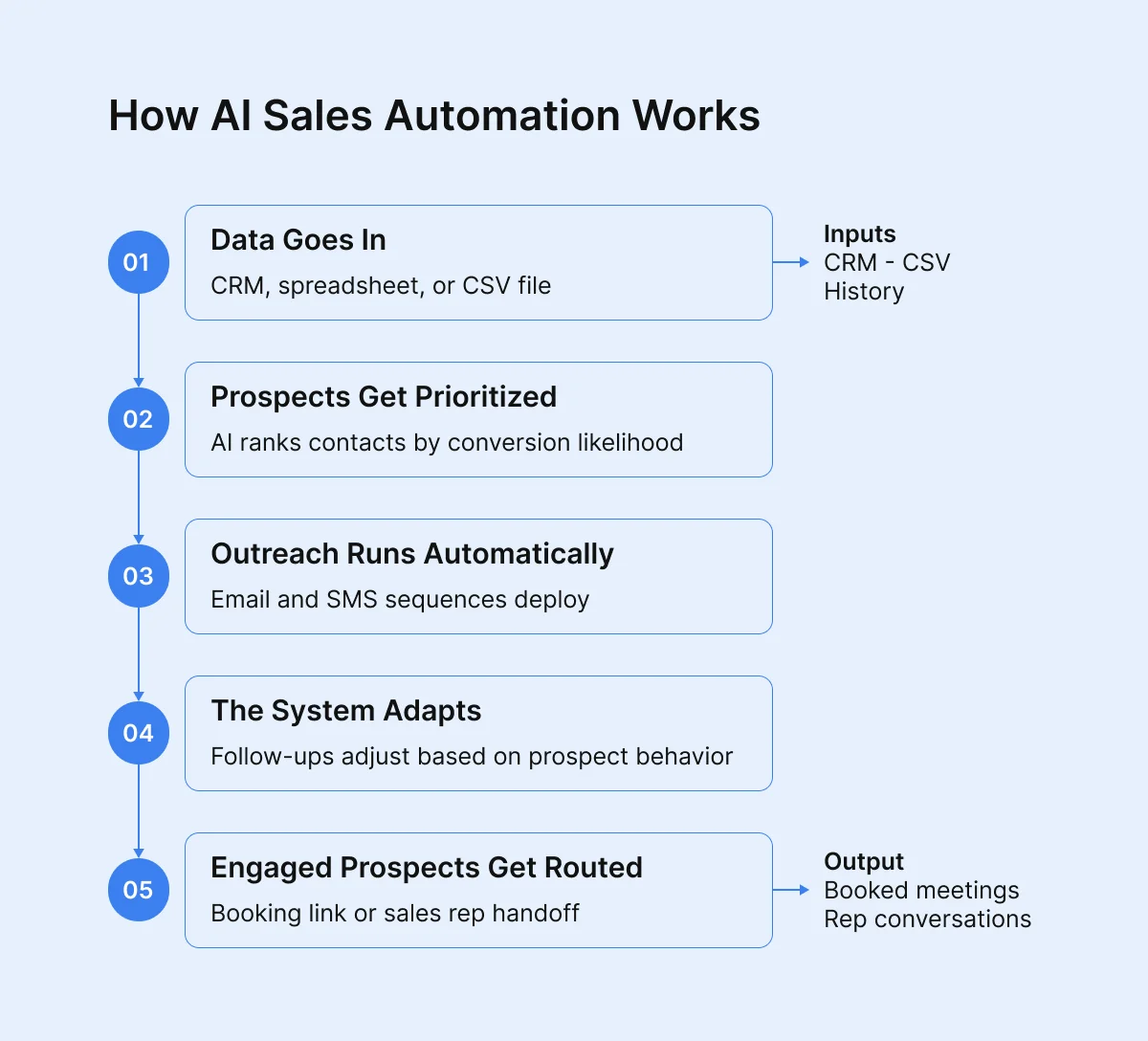
Understanding the mechanics helps set realistic expectations before any tool gets evaluated or implemented. Here is how a typical AI sales automation workflow runs from start to finish.
Step 1: Data Goes In
The system ingests existing contact data from a CRM, spreadsheet, or CSV file. No manual reformatting is required. The contacts, company details, and any previous engagement history get pulled directly into the system.
Step 2: Prospects Get Prioritized
Rather than working through a contact list in order, the system analyzes the data using criteria like industry, company size, location, and previous engagement to surface the contacts most likely to convert first.
Step 3: Outreach Runs Automatically
Email and SMS sequences go out based on the prioritized list. Timing, messaging, and follow-up frequency are handled without a rep manually managing each touchpoint or keeping track of who has been contacted.
Step 4: The System Adapts
Follow-ups adjust based on what each prospect does. A contact who opens an email but does not reply receives a different message than one who ignores the outreach entirely. The sequence responds to behavior rather than running on a fixed schedule.
Step 5: Engaged Prospects Get Routed
When a prospect responds or books a meeting, they move out of the automated sequence. The conversation shifts to a sales rep at the point where human judgment and relationship-building add the most value.
5 Benefits of AI Sales Automation
AI sales automation delivers measurable improvements across the sales process, from the first prospecting touchpoint to pipeline visibility. The benefits below apply across team sizes and industries.
1. More Time Spent Selling
The majority of a sales rep's day goes to tasks that have nothing to do with closing deals. Contact research, data entry, follow-up scheduling, and CRM updates consume hours that would be better spent in conversations with prospects.
Automation handles those tasks in the background. Reps work from a prioritized contact list, outreach runs automatically, and records update without manual input. The time that was going to preparation shifts to actual selling.
2. Consistent and Timely Follow-Up
Manual follow-up is inconsistent by nature. Leads go cold not because a rep forgot about them, but because managing follow-up across a full pipeline without automation is difficult to do consistently at any volume.
Automated sequences ensure every contact receives the right message at the right time based on their behavior. A prospect who opens an email but does not reply gets a different follow-up than one who ignored the outreach entirely, without a rep having to track or manage any of it.
3. Better Prospect Targeting
Outreach based on gut instinct or a manually built list produces inconsistent results. AI automation analyzes behavioral signals, firmographic data, and engagement history to surface the contacts most likely to convert, so outreach goes to the right people first rather than working through a list in order.
The result is a higher proportion of outreach that lands with prospects who are actually in a position to buy, which improves conversion rates without increasing outreach volume. McKinsey research found that companies investing in AI are seeing a revenue uplift of up to 15% and a sales ROI uplift of up to 20%.
4. More Outreach, Same Team Size
Growing outreach volume manually means growing the team and automation removes that dependency. Sequences run across a full contact list simultaneously, follow-ups trigger without rep involvement, and the pipeline gets worked consistently regardless of how many reps are on the team.
A small sales team can cover significantly more pipeline than it could manually without the overhead of additional hires.
5. Cleaner Pipeline Data and More Accurate Forecasting
Pipeline data degrades fast when it relies on reps updating records manually. Contacts go outdated, activity does not get logged, and sales leaders make decisions based on an incomplete picture.
Automated systems log activity, enrich contact records, and keep the pipeline current without rep input. This gives you a more accurate view of where deals stand, which leads to better forecasting and more informed decisions on where to focus your efforts.
5 Best Practices for AI Sales Automation
Getting results from AI sales automation depends less on which tool you choose and more on how you implement it. These practices consistently separate effective implementations from expensive ones.
1. Start with One Challenge
The most common mistake businesses make is trying to automate everything at once. Identify the single highest-impact challenge in your current sales process and address that first. Whether that is inconsistent follow-up, a backlog of unworked contacts, or poor-quality prospecting data, solving one problem well builds the foundation for everything that follows.
From experience: Teams that spread automation across multiple workflows rarely optimize any of them fully. Focused implementations consistently deliver up to 15% efficiency gains compared to fragmented rollouts. A narrow focus compounds results faster than a broad one.
2. Clean Your Data Before Automating
AI automation is only as good as the data feeding it. Severely outdated contact records, duplicate entries, and incomplete CRM data will produce poor results regardless of how sophisticated the system is. Audit and clean your contact data before any automation goes live. This step is consistently skipped and consistently causes implementations to underdeliver.
From experience: The scale of the problem surprises most teams. B2B contact data decays at 18 to 25% per year, and up to 91% of CRM records carry some form of error at any given time. Running automation on that foundation scales the problem rather than solving it.
3. Keep Humans in the Loop at the Right Points
Automation should handle execution. Human judgment should handle strategy, brand voice, and any interaction where relationship-building matters. Define the handoff point clearly, the moment where an automated sequence transitions to a live rep conversation, before building any workflow.
From experience: Fully automated sequences consistently underperform at the closing stage. Teams that introduced human touchpoints at the right moments achieved 2x the win rate compared to market averages. Automation scales the front of the funnel. Human judgment still closes it.
4. Set Measurable Goals Before Implementation
Vague outcomes like "improve efficiency" make it impossible to evaluate whether the implementation is working. Set specific, measurable targets before go-live: response rate improvement, pipeline coverage increase, or time saved on admin tasks per rep per week. Review these metrics at 30, 60, and 90 days to catch problems early and make adjustments before they compound.
From experience: Every successful implementation starts with a specific goal before a single workflow goes live. 76% of companies achieve positive ROI from sales automation within 12 months when they enter with clear objectives. Without that clarity, most teams cannot tell whether the investment is actually working.
5. Plan for Ongoing Refinement
Most vendors hand over a configured system and step back. AI sales automation requires ongoing adjustment as your pipeline evolves, your team changes, and your market shifts. Build a plan for regular review and refinement into the implementation from the start, rather than treating it as a set-and-forget tool.
From experience: The biggest performance drops happen 60 to 90 days after go-live, when teams stop iterating. AI implementation data shows data quality concerns nearly doubled as a top obstacle between 2024 and 2025, largely because systems get deployed and never updated. Teams that review monthly improve consistently. Those that do not decline within a quarter.
What an Effective AI Sales Automation Solution Should Include
Not every tool marketed as AI sales automation delivers the same capabilities. Before evaluating any platform, here is what a solution should actually cover to be worth the investment.
- Behavior-adaptive outreach: The system should adjust follow-up timing and messaging based on how each prospect responds, not follow a fixed schedule regardless of engagement. This is the core distinction between AI automation and basic email sequencing.
- Clean contact data handling: The solution should ingest existing CRM or CSV data without requiring manual reformatting, and should flag or enrich outdated records automatically rather than running outreach on stale information.
- Prospect routing: Engaged prospects should move automatically from the automated sequence to a booking link or sales rep without manual handoff. Every gap in this transition costs the pipeline.
- Private data infrastructure: Contact data, CRM records, and engagement history are sensitive. The solution should run on private, isolated infrastructure where client data is never shared with third parties or used to train public AI models.
- Ongoing support after go-live: The implementation is not complete at launch. An effective solution includes continued refinement and adjustment as the business evolves, not just a configured tool handed over and abandoned.
How to Choose the Right AI Sales Automation Solution
For teams with straightforward outreach needs and the internal resources to manage a platform independently, a standard SaaS tool is a practical starting point. For businesses with specific workflows, sensitive data requirements, or a pipeline that does not fit a standard mold, a custom system built around how the team already operates will consistently outperform a generic product.
The key questions to ask before choosing:
- Does this solve my actual bottleneck, or the one the vendor assumes I have?
- Where is my data hosted, and who has access to it?
- What does the real cost look like at my team size and outreach volume, including add-ons and onboarding fees?
- What support exists after setup, and how does the system get adjusted as my pipeline evolves?
For a full breakdown of the top AI sales automation tools in 2026, including pricing, key features, and a comparison table, see our guide to the best AI sales automation software.
How We Capture Sales Helps Businesses Implement AI Sales Automation
Most standard AI sales automation platforms work well for teams with the internal resources to configure, maintain, and optimize them. For businesses that need a system built around their specific workflow rather than a generic template, We Capture Sales takes a different approach.
Every engagement starts with a one-on-one discovery conversation before anything is built. From there, two products address the automation use cases covered in this article:
- Pipeline Revival: Ingests existing CRM or CSV data and runs targeted email and SMS sequences with follow-ups that adapt based on prospect behavior
- Market Miner: Pulls verified contact data filtered by industry and location and exports clean CSV files ready for immediate outreach
Both run on private, AWS-based infrastructure in a fully isolated environment. Client data is never sold, shared, or used to train public AI models. Support continues after go-live as the system evolves with the business.
Not sure which automation use case to prioritize first?
Reach out for a free consultation and find out exactly where to start.
Frequently Asked Questions
What is the difference between sales automation and AI sales automation?
Traditional sales automation follows fixed rules. The same next step triggers every time regardless of context. AI sales automation reads behavioral signals in real time and adjusts accordingly, making it more accurate and less rigid as it processes more data over time.
How do you measure the ROI of AI sales automation?
The most reliable indicators are changes in pipeline coverage, response rates, and time spent on non-selling tasks before and after implementation. Businesses that start with a clearly defined bottleneck tend to see measurable movement within 60 to 90 days.
What data does AI sales automation need to work effectively?
At minimum, accurate contact records with email addresses, company information, and previous engagement history. The quality of that data directly affects output quality. Severely outdated or incomplete records need addressing before any automation goes live.


