




Picking the right AI sales automation software comes down to one question: What is the biggest bottleneck in your current sales process? The tool that solves that problem is the right one. Gartner found that sellers who effectively partner with AI tools are 3.7x more likely to meet quota than those who do not. The gap is real, and it is widening.
In this article, you will find 8 best AI sales automation tools in 2026, a breakdown of what each one does best, and a practical guide on how to choose between them.
Key Takeaways
- AI sales automation covers five core functions: prospecting, outreach sequencing, pipeline data management, conversation intelligence, and forecasting
- The right tool depends entirely on your biggest bottleneck and whether it solves it, not on which platform has the longest feature list
- Most off-the-shelf tools are built for broad adoption and require businesses to adapt your workflows to the software
- Custom workflow-fit solutions consistently outperform generic tools for businesses with specific operational needs
What to Look for When Choosing AI Sales Automation Software
With dozens of tools claiming to do the same thing, it helps to filter by what actually matters for your specific operation before evaluating any platform.
- Start with your bottleneck: The most common mistake is buying a tool that solves the wrong problem. If your issue is inconsistent follow-up on existing contacts, you need outreach automation. If your issue is poor-quality prospecting data, you need a data tool first.
- Check how the tool handles your data: Where is your contact data hosted? Who has access to it? Is it used to train third-party AI models? For businesses handling sensitive client or CRM data, private infrastructure and data isolation are non-negotiable.
- Understand the real cost: Many tools advertise a low starting price that does not reflect what most teams actually pay once credits, add-ons, and onboarding fees are included. Ask for a total cost estimate based on your team size and outreach volume before committing.
- Ask what happens after setup: Most providers hand over a configured tool and step back. Ongoing refinement, team training, and system adjustments as your pipeline evolves matter as much as the initial implementation.
Tool vs. Custom AI Systems: What Is the Difference?
Most AI sales automation software is a product built for the broadest possible market. You configure it, connect your CRM, and work within the boundaries of what the platform supports. When your process does not fit the template, you adapt your process.
A custom AI system works the other way around. It is built around how your team already operates, which means the workflow, the outreach logic, and the data handling are all specific to your business rather than inherited from a generic product.
The tradeoff is that custom systems require a discovery process and a higher initial investment. The advantage is a solution that actually fits, with ongoing support to refine it as your sales operation evolves.
For teams with straightforward outreach needs and the internal capacity to manage a self-serve tool, a standard platform is a practical starting point. For businesses with specific workflows, sensitive data requirements, or a pipeline that does not fit a standard mold, a custom system is worth the investment.
The 8 Best AI Sales Automation Software Tools in 2026
Not all AI sales automation tools serve the same purpose. Some handle outreach and re-engagement. Others focus on contact data, pipeline visibility, or conversation intelligence. The table below gives you a quick comparison before the full breakdown.
Note: Some tools on this list, like We Capture Sales, offer custom AI solutions rather than traditional SaaS platforms. These are included for teams looking for more advanced, tailored automation.
1. We Capture Sales – Custom AI Solution for Sales
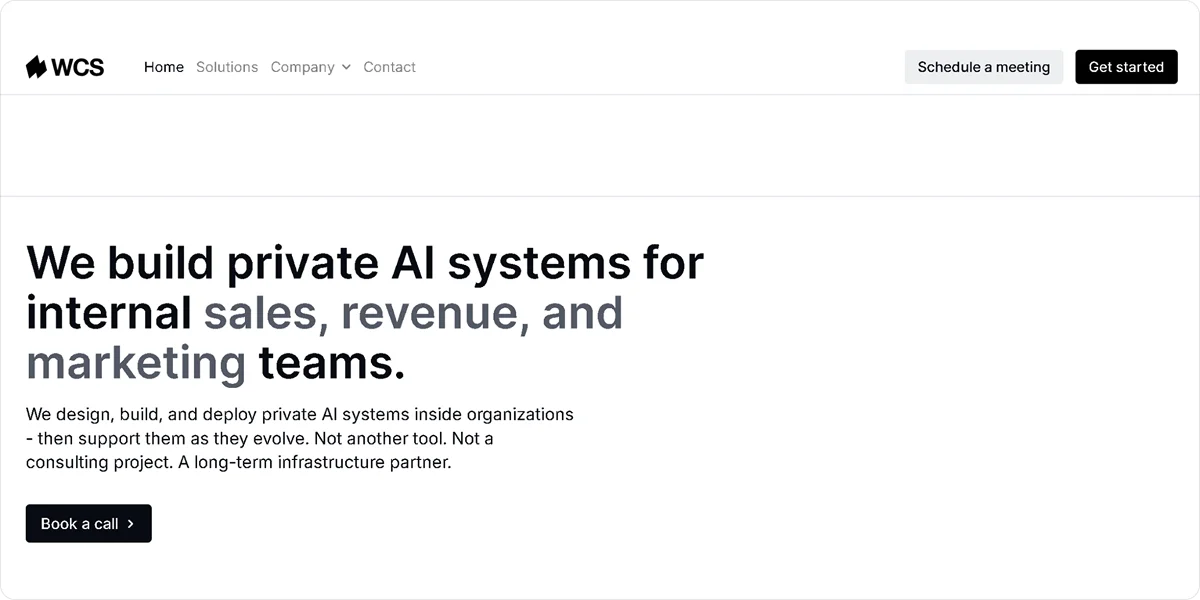
We Capture Sales takes a different approach compared to traditional AI sales automation platforms. Instead of offering a plug-and-play tool, it builds fully customized AI systems tailored to your sales processes, data, and workflows. Every implementation starts with a one-on-one discovery call to ensure the system fits how your team already operates before anything is built.
Use We Capture Sales if:
- You want to replace or upgrade your entire sales automation system rather than add another disconnected tool
- You have complex workflows or internal data that generic platforms cannot accommodate
- You want AI built specifically around your business rather than configuring a one-size-fits-all product
- You care about long-term automation infrastructure with ongoing support and refinement after go-live
Best for: Scaling companies, operations-heavy teams, and businesses building proprietary go-to-market systems that require more than a standard SaaS platform can deliver.
Key Features
- CRM and CSV ingestion: Pulls existing contact data directly from your CRM platform or uploaded CSV files into the system without manual reformatting or data cleanup
- Behavior-adaptive outreach: Adjusts email and SMS follow-ups automatically based on how each prospect responds rather than running on a fixed schedule
- Prospect routing: Converts engaged contacts into booked meetings through embedded Calendly links or direct website routing
- Contact data extraction: Scrapes verified contact information filtered by industry and location through Market Miner and exports clean CSV files ready for immediate use
- Private data environment: Hosts all your data on an isolated, AWS-based infrastructure that is never sold, shared, or used to train public AI models
Pros
- Builds solutions around your specific workflow rather than forcing the business to adapt to generic software
- Offers support well after go-live, with system refinements as your business grows
- Allows you to operate in a fully isolated data environment with no third-party data sharing
Cons
- Applies startup fees in addition to monthly subscription costs
Pricing
We Capture Sales pricing starts at a $950 startup fee plus $750 per month plus usage for Market Miner, and a $2,000 startup fee plus $750 per month plus usage for Pipeline Revival.
Not best for: Businesses looking for a self-serve, instant-setup tool with no onboarding.
2. Apollo.io – All-in-One Prospecting and Outreach Plaform
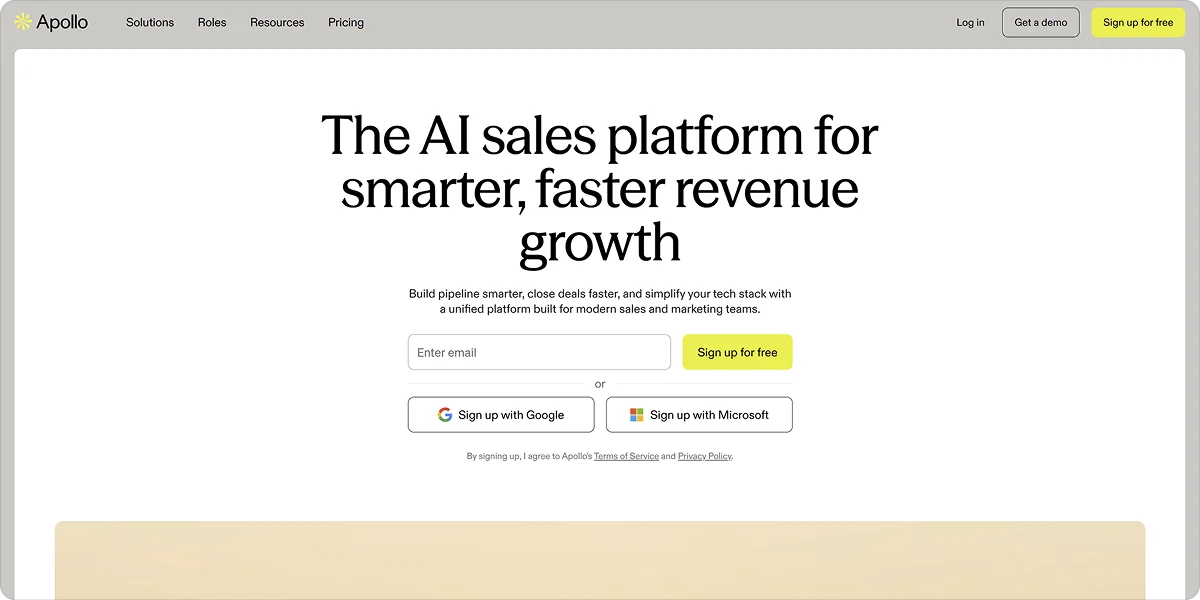
Apollo.io is a B2B contact database and sales engagement platform that combines prospecting, outreach sequencing, and CRM integrations in one place. It suits teams that need volume prospecting alongside basic automation without managing multiple tools.
Key Features
- Contact database: Searches and filters over 210 million B2B contacts by industry, company size, location, and firmographic criteria
- Lead scoring: Prioritizes prospects based on behavioral signals and firmographic fit to surface the most relevant contacts first
- Email sequencing: Automates multi-step outreach with open and reply tracking built in
- CRM sync: Syncs contact and activity data with Salesforce and HubSpot to keep records current automatically
- Intent data: Identifies buying signals and in-market accounts on higher-tier plans to improve targeting precision
Pros
- Combines prospecting data and outreach sequencing in a single platform, reducing tool sprawl
- Provides a free tier with access to core features without a credit card
- Offers wide CRM integration coverage that suits teams already using established sales tech stacks
Cons
- Offers a credit-based pricing model, which means actual costs often exceed the advertised rate as outreach volume scales
Pricing
Apollo.io pricing starts at $59 per user per month for the Basic tier.
Not best for: Teams that need behavior-adaptive follow-up or SMS outreach beyond basic email sequencing.
3. Reply.io – Multichannel Sales Engagement Platform
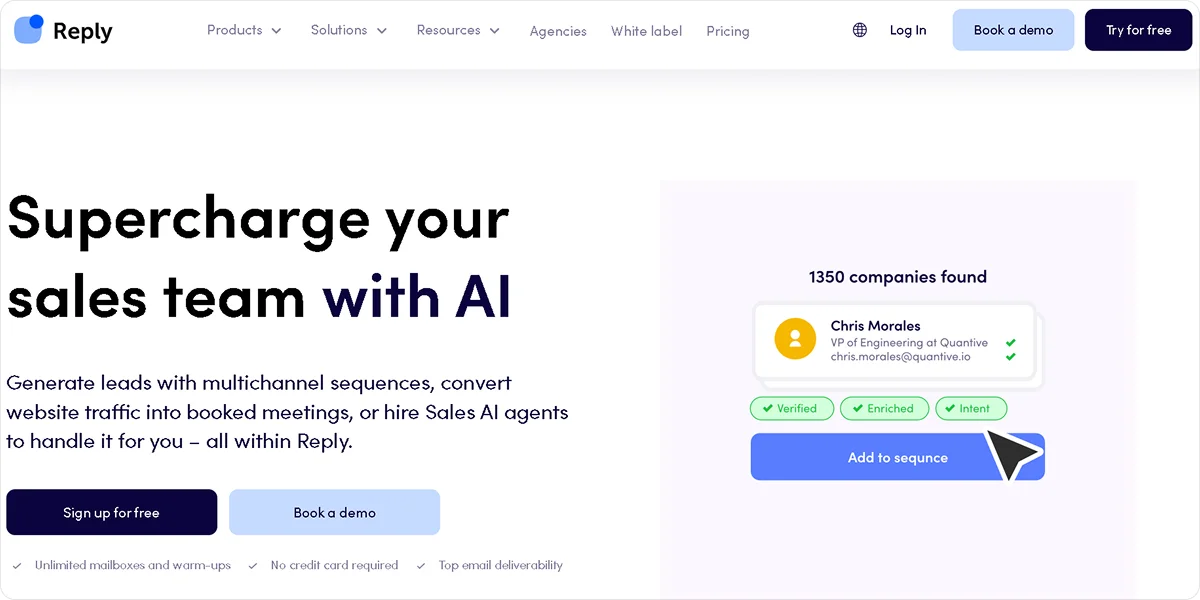
Reply.io is a multichannel sales engagement platform that automates outreach across email, LinkedIn, SMS, and phone calls from a single workflow. It includes Jason, an AI agent that handles prospecting, personalized messaging, and response management automatically.
Key Features
- Multichannel sequencing: Builds and runs automated outreach sequences across email, LinkedIn, SMS, and phone within a single platform
- AI reply handling: Uses Jason AI to manage prospect responses, classify replies, and trigger appropriate follow-up actions without manual input
- Inbox warmup: Runs automated warmup on all connected email accounts to protect sender reputation and deliverability
- Conditional logic: Adjusts sequence flows based on engagement signals, routing prospects down different paths depending on how they respond
- CRM integration: Syncs contact data, activity, and sequence status with Salesforce, HubSpot, and Pipedrive
Pros
- Covers email, LinkedIn, SMS, and phone in one platform, reducing the need for separate tools per channel
- Handles response classification and follow-up triggers automatically, saving significant manual time
- Offers a 14-day free trial on all plans with access to core features
Cons
- Limits multichannel capabilities to higher-tier plans, making the entry price misleading for teams that need full channel coverage
- Does not offer protection to account restriction risks that comes with LinkedIn automation
Pricing
Reply.io pricing starts at $99 per user per month for the multichannel plan.
Not best for: Teams that rely primarily on phone outreach or need SMS as a primary channel without email.
4. Instantly – High-Volume Cold Email Automation Tool
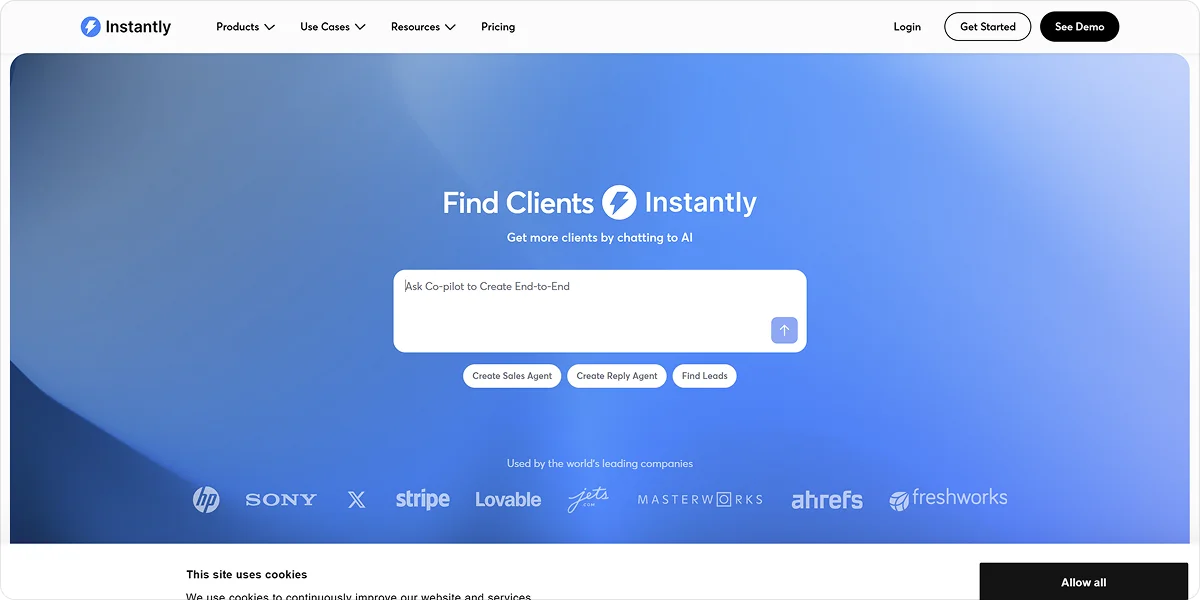
Instantly is a cold email automation platform focused on deliverability and sequence management at scale. It supports unlimited email accounts and automated inbox warmup on all plans, keeping base costs predictable as outreach volume grows.
Key Features
- Unlimited sending accounts: Connects as many email accounts and domains as needed without per-seat costs, keeping base pricing flat as outreach scales
- Automated inbox warmup: Runs warmup sequences on all connected accounts automatically to maintain sender reputation and inbox placement
- Email sequence management: Sends and tracks outreach campaigns with scheduling, follow-up automation, and reply detection
- Campaign analytics: Monitors open rates, reply rates, and deliverability metrics across all active campaigns from a unified dashboard
- AI reply classification: Categorizes prospect responses automatically to trigger the appropriate next action in the sequence
Pros
- Offers unlimited email accounts on all plans, making it one of the most cost-effective options for high-volume email outreach
- Provides deliverability infrastructure, including warmup, blacklist monitoring, and placement testing, which is built in rather than sold as an add-on
- Allows teams to launch campaigns quickly without technical configuration overhead
Cons
- Restricts to email only on base plans, with SMS and CRM features requiring separate add-on subscriptions
- Limits contact on lower-tier plans restrict volume for teams building larger outreach campaigns
Pricing
Instantly pricing starts at $47 per month for the Growth Outreach plan, which supports 1000 uploaded contacts and 5,000 emails per month.
Not best for: Teams that need multichannel outreach beyond email or behavior-adaptive follow-up sequences.
5. Salesloft – Enterprise Sales Engagement and Intellignece Platform
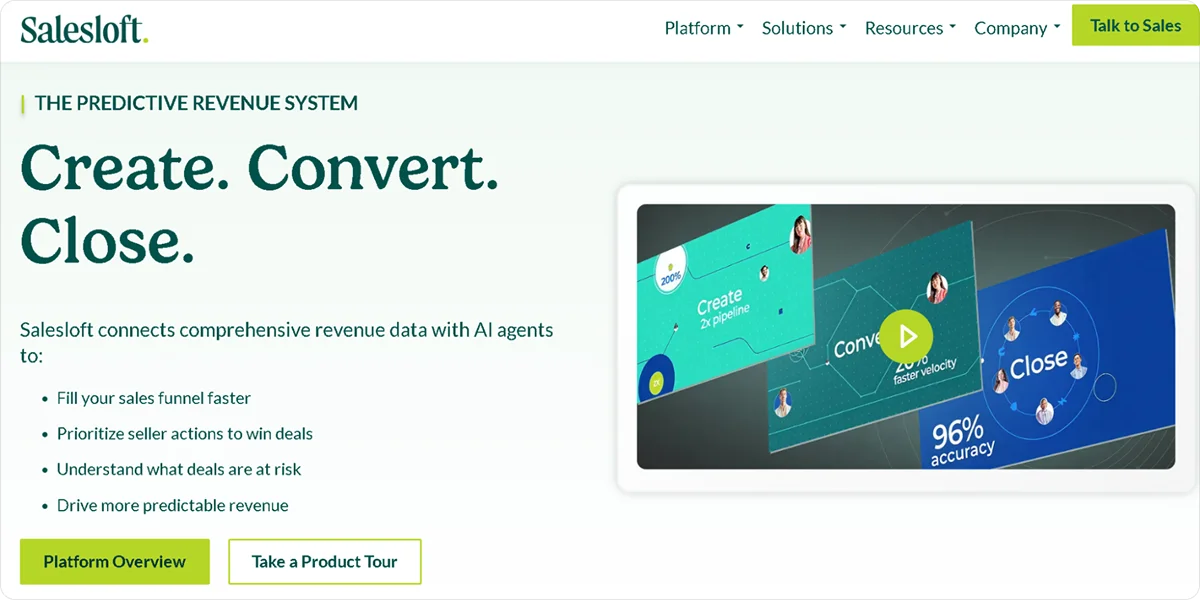
Salesloft is a sales engagement platform built for larger teams that need disciplined, AI-guided outreach at scale across multiple channels. Its Conductor AI reviews buyer behavior and recommends the best time, channel, and message for each prospect automatically.
Key Features
- Cadence automation: Runs multi-channel outreach workflows across email, phone, and LinkedIn with AI-guided timing and channel recommendations
- Conversation intelligence: Records and analyzes sales calls, pulls action items, and surfaces coaching insights for sales managers
- Pipeline visibility: Provides deal health indicators, activity tracking, and forecast data across the entire team in a centralized view
- AI-guided prioritization: Ranks prospects and surfaces the next best action for each rep based on engagement data and historical patterns
- CRM integration: Syncs deeply with Salesforce and HubSpot, pushing call recordings, email activity, and deal updates automatically
Pros
- Combines outreach, conversation intelligence, and pipeline management in one platform, reducing the number of tools a team needs to manage
- Provides actionable, rep-level guidance with Conductor AI, rather than just automating task execution
- Offers strong governance and reporting features that suit revenue operations teams managing multiple reps and regions
Cons
- Does not publicly list pricing and requires a sales conversation, making budget planning difficult upfront
- Has complexity and setup time, making it a poor fit for lean teams without a dedicated sales operations function
Pricing
Salesloft pricing is not publicly listed. Contact Salesloft directly for a quote based on team size and feature requirements.
Not best for: Small or lean sales teams without dedicated sales operations support to manage configuration and ongoing optimization.
6. HubSpot Sales Hub – CRM with Built-In Sales Automation
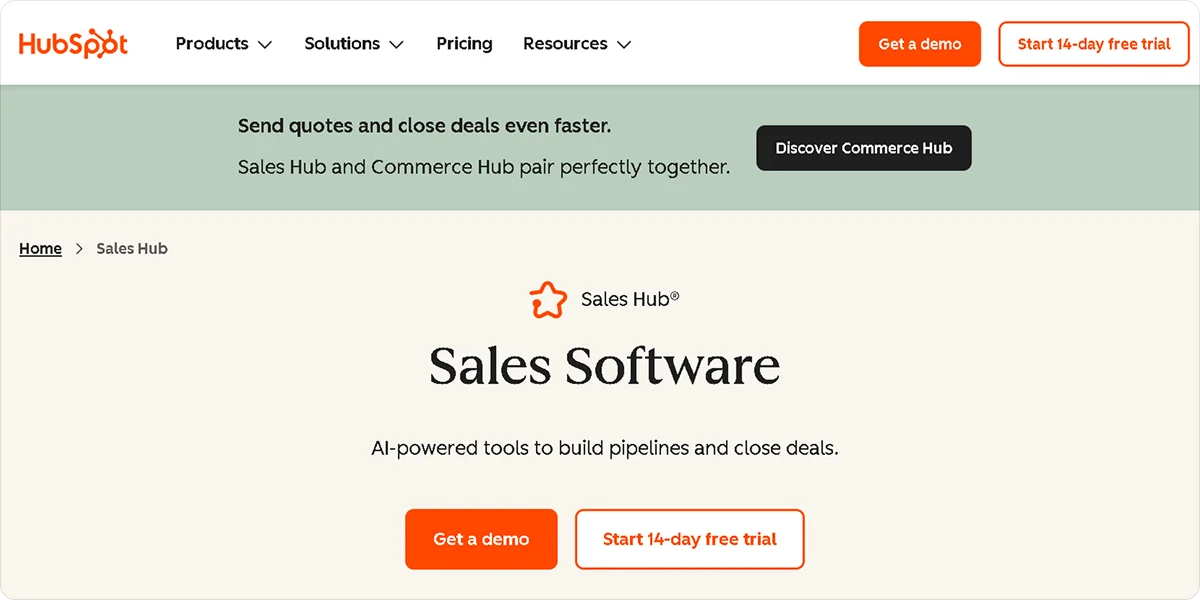
HubSpot Sales Hub is a CRM with built-in sales automation, including email sequences, deal tracking, and AI-assisted lead scoring. It is a practical starting point for teams that need contact management and outreach automation in a single platform without managing a separate CRM.
Key Features
- Pipeline management: Tracks deals, contacts, and sales activity in a centralized CRM with customizable pipeline stages and deal properties
- Email sequence automation: Sends automated, multi-step outreach sequences with follow-up scheduling on Professional and above plans
- AI-assisted lead scoring: Ranks prospects by conversion likelihood using predictive scoring based on behavioral and engagement data
- Activity tracking: Logs email opens, clicks, and prospect engagement automatically without requiring manual CRM updates from reps
- Reporting dashboards: Provides sales performance reporting, rep activity tracking, and forecast data across all plans
Pros
- Combines CRM, outreach automation, and reporting in one platform, eliminating the need for a separate contact management tool
- Free plan provides genuine CRM functionality, making it accessible for teams not ready to commit to a paid subscription
- Integration with over 1,500 applications gives teams the flexibility to connect existing tools without custom development
Cons
- Email sequences are only available from the Professional plan upward, meaning Starter plan users cannot automate outreach without upgrading
- One-time onboarding fees on Professional and Enterprise plans add a high upfront cost beyond the advertised monthly rate
Pricing
HubSpot Sales Hub offers a free plan for up to two users. Paid plans start at $15 per user per month for the Starter plan.
Not best for: Teams that need outreach sequencing without committing to the Professional plan or paying upfront onboarding fees.
7. Gong – Revenue Intelligence and Conversation Analytics Platform
Gong is a revenue intelligence platform that records and analyzes sales calls, surfaces winning behaviors, and provides deal forecasting based on conversation data. It is the leading tool in the conversation intelligence category and is widely used by mid-market and enterprise sales teams.
Key Features
- Call recording and transcription: Records, transcribes, and stores all sales calls and meetings with searchable, timestamped content
- Conversation analytics: Identifies patterns in successful calls, tracks talk-to-listen ratios, and flags objections and competitor mentions automatically
- Deal intelligence: Surfaces deal risks, tracks engagement across stakeholders, and highlights deals most likely to close or stall
- Forecast accuracy: Builds pipeline forecasts from call and engagement data rather than relying on rep-entered CRM updates
- Coaching tools: Provides rep-level performance data, call scorecards, and recommended coaching actions for sales managers
Pros
- Providers conversation analytics that goes significantly deeper than basic call recording, surfacing actionable patterns across the entire team's pipeline
- Deal intelligence based on actual call and engagement data produces more accurate forecasts than manual pipeline reviews
- Offers coaching recommendations tied to specific behaviors rather than general performance metrics
Cons
- Does not publicly list pricing and typically requires a significant investment, making it inaccessible for smaller teams
- Limits value for teams where most selling happens through written outreach rather than phone or video calls
Pricing
Gong pricing is typically structured per user per year and varies based on team size and modules selected. Contact Gong directly for a quote.
Not best for: Small teams with limited call volume or teams where outreach is primarily written rather than phone or video-based.
8. Salesforce Einstein – AI Layer for the Salesforce Ecosystem
Salesforce Einstein is an AI layer built directly into the Salesforce CRM, adding predictive lead scoring, activity capture, deal insights, and forecast modeling for teams already operating within the Salesforce ecosystem. It enhances existing Salesforce workflows without requiring a separate tool or data migration.
Key Features
- Predictive lead scoring: Ranks leads by conversion likelihood using historical deal data and behavioral patterns from within the CRM
- Activity capture: Logs emails, calendar events, and calls automatically, removing the need for manual CRM updates after every interaction
- Opportunity insights: Surfaces deal risks, highlights key factors influencing outcomes, and recommends next actions for each open opportunity
- Einstein forecasting: Predicts sales outcomes based on CRM data, pipeline patterns, and historical performance across the team
- Conversational interface: Einstein Copilot allows reps to query CRM data, get deal summaries, and take actions using natural language
Pros
- Works entirely within the Salesforce ecosystem, eliminating integration complexity and data migration for existing Salesforce users
- Improves over time as it processes more deals and activity data, making predictions more accurate the longer a team uses it
- Reduces time spent navigating the CRM by allowing reps to get answers and take actions through conversation
Cons
- Limits value if you already use Salesforce as your primary CRM, offering no standalone use case outside the ecosystem
Pricing
Salesforce Einstein requires you to contact sales for custom quote.
Not best for: Teams not already using Salesforce or those seeking a standalone AI sales automation tool outside the Salesforce environment.
How We Capture Sales Approaches AI Sales Automation
Most tools on this list are built for the widest possible audience. They work well for teams with the internal capacity to configure, manage, and optimize them. For businesses that need a system built around how your team actually operates, We Capture Sales takes a different approach.
Every engagement starts with a one-on-one discovery conversation before anything is built. The goal is to understand the specific bottlenecks, the existing workflow, and what a practical solution looks like for that business. Nothing gets deployed until that picture is clear.
Two products address the core sales automation use cases directly:
- Pipeline Revival: Ingests existing CRM or CSV data and runs targeted email and SMS sequences with automated follow-ups that adapt to each prospect's response. Converts engaged prospects through embedded Calendly booking links or direct website routing
- Market Miner: Pulls verified contact data from the web, filtered by industry and location, and exports clean, structured CSV files ready for immediate use in outreach campaigns
Every solution runs on private, AWS-based infrastructure. You operate in a fully isolated environment, and your data is never sold, shared, or used to train public AI models. Support continues well after go-live.
Not sure which tool is the right fit for your sales operation?
Reach out for a free consultation and find out exactly where to start.


