




Staying on top of every contact in a growing pipeline is harder than it sounds. Between meetings, new leads coming in, and competing priorities, follow-up on a promising conversation from last week often gets pushed to tomorrow and then forgotten entirely.
Forrester's 2024 State of Business Buying report found that 86% of B2B purchases stall during the buying process, and inconsistent follow-up is one of the most consistent contributors.
To help you avoid that problem, sales follow-up automation software handles the timing, sequencing, and routing of outreach automatically so contacts stay active without your team manually tracking each one.
This article covers what sales follow-up automation software is, what it does, and what to look for before choosing one.
Key Takeaways
- A sequence built on clean, segmented contact data consistently outperforms one running on an unverified list, regardless of how well the messages are written
- Behavioral sequencing produces better results than fixed drip campaigns because it adjusts what gets sent based on what each contact does rather than following a preset schedule
- CRM integration, multi-channel capability, and defined exit criteria are the three most important factors to verify before committing to any follow-up automation platform
- Consistent follow-up across a large pipeline is a systems challenge, not a capacity one. The right software removes the dependency on a rep remembering to act at the right moment
- We Capture Sales builds custom follow-up automation around how your specific pipeline operates, starting with a demo conversation before any development begins
What Is Sales Follow-Up Automation Software?
Sales follow-up automation software automatically handles the timing, sequencing, and routing of outreach after first contact. Rather than relying on a rep to remember when to follow up, what to say, and which channel to use, the system reads what each contact does and acts on it.
A CRM stores contact data and tracks deal stages. Most CRMs require a rep to log a follow-up task and then complete it. Automation software removes both steps.
Here is how the two approaches compare:
Why Manual Follow-Up Fails at Scale
Following up consistently is straightforward when a pipeline has ten contacts. At fifty, the same process starts breaking down. Three specific patterns account for most of the follow-up that never happens.
Reps Run Out of Time
Sales professionals spend only 23% of their working week on direct selling, according to the Forrester Sales Activity Study, with the rest consumed by administrative tasks, internal meetings, and preparation.
Follow-up is one of the first things that slips when a rep is stretched across a full pipeline. A contact who showed genuine interest last week may still be worth pursuing today, but receives no outreach because the rep is focused on what is directly in front of them.
A strong process for turning cold contacts into active prospects depends on consistent follow-up, and consistency breaks down the moment it relies on a rep finding time between other priorities.
Follow-Up Prioritization Is Unreliable
When follow-up depends on manual decision-making, the contacts that get attention are the ones the rep happens to remember, not the ones most likely to convert.
Some contacts receive three follow-ups in a week. Others receive none. That inconsistency is a capacity problem. A rep managing fifty contacts at different stages simply cannot give each one the attention the pipeline requires without a system handling the prioritization.
No Visibility into What Is Working
Manual follow-up produces no usable data at scale. A rep can track a handful of contacts manually, but across a full pipeline, identifying which subject lines convert and which sequences stall becomes impossible without a system that can show:
- Which subject lines generate the most responses
- Which follow-up timing converts more contacts into meetings
- Which sequences produce the highest reply rates over a full campaign
Without data from previous campaigns to improve on, every new sequence gets built from scratch using the same guesses about timing and messaging.
What Sales Follow-Up Automation Software Does
Once a contact enters your pipeline, keeping them engaged requires time, consistency, and channel coordination that manual processes struggle to maintain at volume. Here is what sales follow-up automation software handles automatically.
Behavior-Based Sequencing
The software reads what each contact does and adjusts the next step accordingly:
- A contact who opens an email but does not reply gets a follow-up that approaches the conversation from a different angle
- A contact who clicks through to a pricing page gets a message relevant to what they looked at
- A contact who replies gets routed out of the automated sequence and into a direct conversation
This behavioral adaptability is what separates a sequence that improves over time from one that sends the same message to every contact regardless of engagement.
This is one of the core best automation practices: Replies are driven by message relevance, not by sending more messages.
Performance Monitoring and Sequence Optimization
The software continuously tracks open rates, reply rates, and sequence completion. Sequences that underperform get flagged before the outreach budget runs out on contacts who are not engaging.
Sequences that produce high click rates but low replies signal a disconnect between the email and where the contact lands. That is a specific, fixable problem that stays invisible without a system tracking performance continuously.
Multi-Channel Coordination
A contact who stopped opening emails is unlikely to re-engage through the same channel. Coordinating email and SMS from one system reaches contacts through whichever channel they are currently active on without the same message repeating across both.
The timing between channels matters too. A follow-up SMS sent the same day as an email feels like a barrage. Spaced correctly across channels, the same outreach feels considered rather than automated.
Note:
SMS in this context applies to warm contacts who have previously engaged or provided a business number, not cold outreach to unknown prospects.
Automatic Routing at the Right Moment
When a contact crosses a defined engagement threshold, the software routes them directly to a booking link with the full interaction history attached. The handoff happens at the moment of intent, not after a rep notices the signal and decides to act on it.
That window between intent and action is where deals typically go quiet. Removing the manual step closes it, which is one of the most direct applications of automated follow-up that compounds return across a full pipeline.
What to Do With Contacts Who Do Not Respond
A full sequence with no response does not necessarily mean the contact is disqualified. It can also mean the timing was off, the message didn't land, or the contact isn't ready to move forward yet.
Three options cover most situations.
Move Them to a Low-Frequency Nurture Sequence
A contact who opened emails but never replied is worth keeping in a light-touch sequence. Sending relevant content every four to six weeks keeps your brand present without direct sales pressure.
When their situation changes, the familiarity built during the original sequence gives you a head start.
Flag Them for Reactivation
A contact who showed early intent before going quiet may be worth a dedicated reactivation effort in three to six months.
Circumstances change: Budgets reset, priorities shift, and a contact who could not move forward in Q1 may be in a different position by Q3.
A structured approach to lead reactivation recovers pipeline from contacts your team had written off without starting the relationship from scratch.
Remove Them from Active Sequences
A contact who has not opened a single message across multiple channels over an extended period is worth removing from active outreach. Removing them keeps your pipeline clean and your deliverability intact.
The clearest signal for which option applies:
- A contact who opened but never clicked is worth nurturing.
- A contact who has shown no engagement across email and SMS over a full sequence is worth removing.
What to Look for Before Choosing Sales Follow-Up Automation Software
Not all follow-up automation tools work the same way. Before committing to any platform, use these criteria to identify which ones fit how your team operates.
CRM Integration
The software needs to connect to your existing contact data without requiring a manual import every time a new contact enters the pipeline. Confirm it syncs in real time rather than on a schedule.
Sequence activity should also flow back into the CRM, so your team works from one record rather than two sources that never quite match. A disconnected system creates more coordination work than it removes.
Behavioral Adaptability
A fixed drip sequence sends the same message to every contact on the same schedule regardless of what they do. Confirm the software adjusts what it sends based on contact behavior rather than a preset timer.
The difference between a fixed sequence and a behavioral one shows up directly in reply rates.
Multi-Channel Capability
Email-only follow-up limits your reach to contacts who are active in their inbox. Confirm whether the software covers SMS alongside email and whether both channels run from the same system.
A tool that requires separate platforms for email and SMS adds coordination overhead. Both channels should adapt based on the same contact behavior data.
Exit Criteria and Sequence Management
A sequence without a defined endpoint keeps contacting disengaged contacts indefinitely, which damages sender reputation over time. Before committing to any platform, confirm how it handles:
- Opt-outs and unsubscribe requests
- Contacts who complete a sequence without engaging
- Contacts who re-engage after a period of silence
Clear exit criteria protect deliverability and keep your pipeline accurate.
How We Capture Sales Automates Sales Follow-Up
Inconsistent follow-up tends to come down to one thing: The process depends on a rep remembering to act at the right moment across a pipeline of contacts at different stages. As volume grows, that process breaks down.
Pipeline Revival at We Capture Sales is built around that specific gap. Rather than being a platform your team configures and manages, it is a custom system built around your existing contact data and sales workflow.
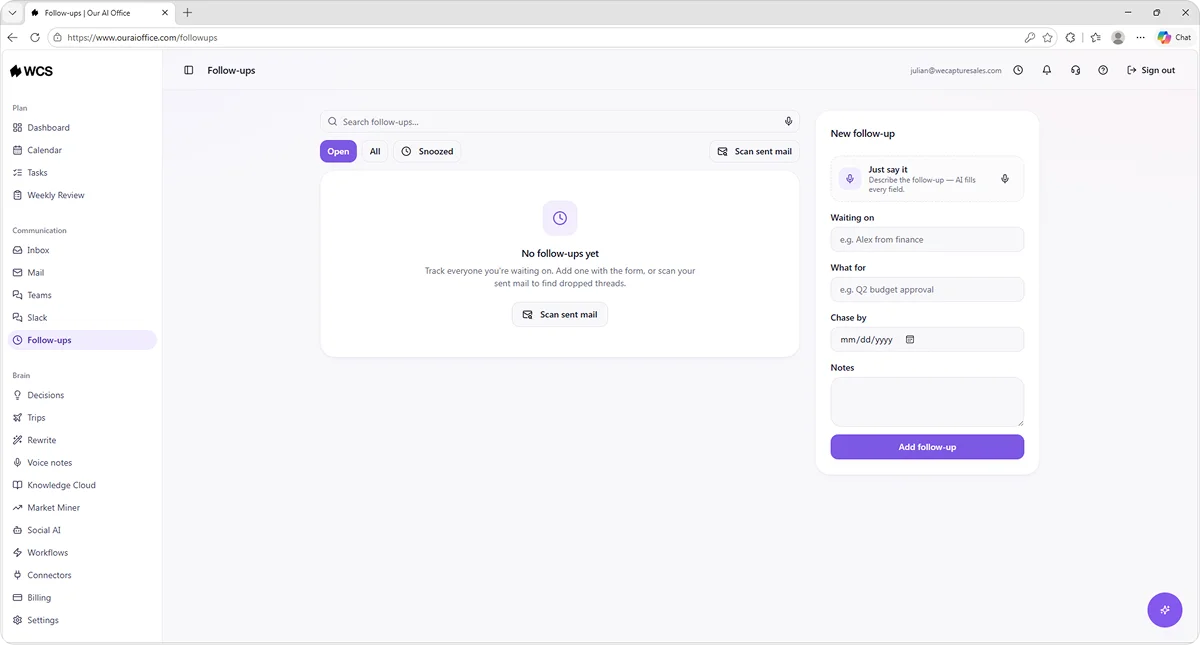
Here is what it covers in practice:
- Behavior-based sequencing: Runs email and SMS sequences that adapt based on open rates and response rates, so each contact receives outreach relevant to where they are in the conversation
- Automatic routing: Routes engaged prospects to a Calendly booking link or your website the moment they cross a defined engagement threshold, without anyone on your team stepping in manually
- Multi-channel coordination: Runs email and SMS from the same platform so both channels adapt based on the same contact behavior data
- Private infrastructure: Runs your contact data in a fully isolated environment that never touches a public AI model
Pricing is per organization regardless of team size, and every engagement starts with a demo conversation that maps your current follow-up process before any build begins. That conversation identifies where contacts are being lost and determines what the right sequence structure looks like for your pipeline.
Book a demo with the We Capture Sales team to get started.
Frequently Asked Questions
How many follow-ups should an automated sequence include?
It depends on the goal of the sequence and where the contact is in the pipeline. A post-demo sequence typically runs three to five touches over two weeks. A cold outreach sequence runs longer, usually five to eight touches over three to four weeks.
What is the best time to send a follow-up email?
There is no universal best time for every contact. Send-time optimization analyzes each contact's historical engagement patterns and sends an email when they are most likely to open it.
Without send-time optimization, Tuesday through Thursday between 8am and 10am or 4pm and 6pm consistently produce stronger open rates across most B2B audiences than Monday mornings or Friday afternoons.
How do you know if your follow-up automation is working?
Three metrics cover most of what you need: open rate, reply rate, and sequence completion rate. If open rates drop, the subject line or send time needs adjusting. If reply rates drop while open rates hold, the message content needs work.
If contacts are dropping off sequences early, the sequence is either too long or the gap between touches is too short. Review these monthly rather than waiting for a quarterly pipeline report.


