





Custom SaaS development quotes vary so widely that most founders cannot tell whether what they are being charged is reasonable or inflated. The range is real, and it is wide, because the variables that drive cost, feature scope, team location, compliance requirements, and post-launch expenses all pull the number in different directions
This article breaks down what custom SaaS development costs, what realistic budgets look like at each stage, and the costs most businesses do not account for until after the build is done.
Key Takeaways
- Feature scope is the single biggest cost driver in any custom SaaS build. Every feature added to the project adds design, development, testing, and maintenance work
- Post-launch costs, including maintenance, cloud infrastructure, and third-party tool subscriptions, routinely push total investment well beyond the original build quote
- Where your development team is located has a significant impact on hourly rates and total project cost
- A well-scoped discovery process before development begins typically prevents a significant amount of wasted build work and budget overruns
- The businesses that get the most out of a custom SaaS investment start lean, validate demand early, and scale the product from there
What Drives Custom SaaS Development Cost
No two custom SaaS projects cost the same, but the variables that determine where your project lands are consistent. Understanding them before you speak to a developer puts you in a much stronger position to evaluate quotes and plan a realistic budget.
Feature Scope and Complexity
The number and complexity of features your product requires is the single biggest line item in any custom SaaS build. Basic features like user authentication, a standard dashboard, and transactional email are relatively predictable to build.
Complex features like AI integration, real-time data processing, multi-tenancy, and custom reporting require specialized skills and longer timelines. Feature creep is the most common reason projects exceed their original budget. Deciding what belongs in version one versus version two before development begins is one of the most cost-effective decisions you can make early on.
Team Location and Seniority
Where your development team is based has a direct impact on your hourly rate and total project cost. According to Clutch's 2026 Software Development Pricing Guide, US and Canadian teams charge $100 to $149 per hour, Eastern European teams like those in Poland charge $50 to $99, and offshore teams in India, Ukraine, and the Philippines charge $25 to $49 per hour.
Seniority matters as much as location. A senior engineer who architects the system correctly from the start costs more per hour but produces fewer expensive fixes later in the project.
Compliance Requirements
Building for regulated industries adds meaningful cost in both development time and ongoing audit requirements. GDPR, HIPAA, and SOC 2 each require specific technical controls, documentation, and regular audits that continue well past launch.
For businesses in fintech, healthcare, or enterprise software, compliance should be treated as a recurring budget line, not a one-time build cost.
Integrations and Third-Party Dependencies
Every integration your product requires adds design, development, testing, and maintenance work. A SaaS product connecting to a CRM, a payment processor, and an analytics platform costs more to build and maintain than one with no external dependencies.
The more integrations you need at launch, the higher your build cost and your ongoing maintenance obligation.
Timeline and Urgency
Compressed timelines require larger teams or extended hours, both of which push the total cost up. A realistic timeline produces a better product at a lower total cost than one built under pressure.
If your quote includes a significant premium for fast delivery, that is a cost worth examining before you commit.
Custom SaaS Development Cost by Product Type
The clearest way to understand where your project lands on the cost spectrum is by product complexity. The table below covers four build models for what each one typically costs in 2026.
The biggest variable within each tier is scope. A tightly defined MVP with one core workflow costs significantly less than a multi-feature build, and the biggest variable is scope, not the tier itself. Deciding what belongs in version one before development begins is the single most cost-effective decision you can make.
Many businesses also underestimate how much the build model affects total cost. If your team is also evaluating custom AI agent development as part of a broader automation strategy, the same scoping principles apply there, too.
Hidden Costs To Consider
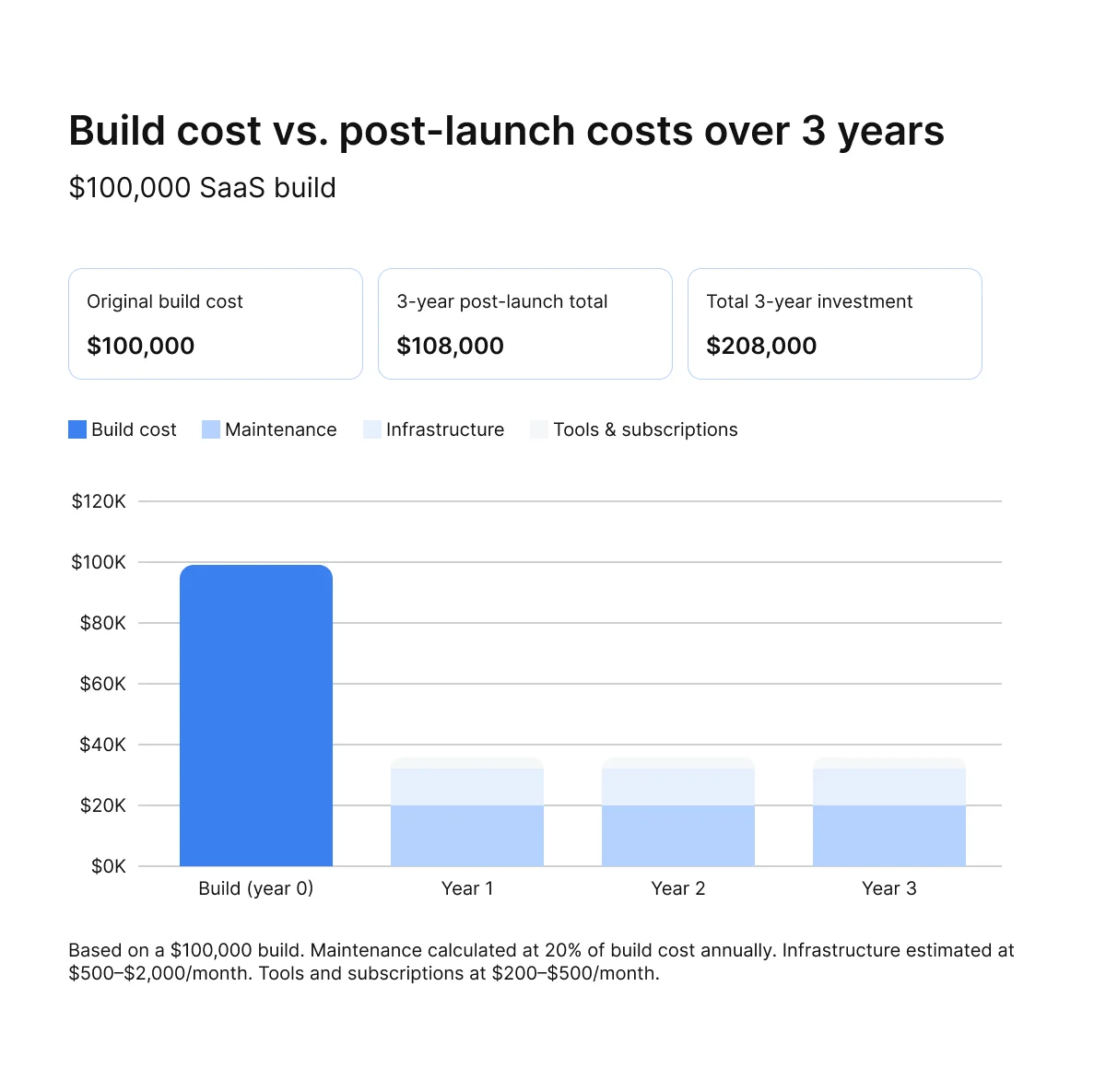
The build cost is only part of the total investment. The costs that consistently surprise founders are the ones that kick in after launch.
Ongoing Maintenance
Every SaaS product requires continuous maintenance after it goes live. Budget 15 to 25% of your original build cost annually for maintenance, security patches, and dependency updates. On a $150,000 build, that is $22,500 to $37,500 per year, every year.
Cloud Infrastructure
Hosting, storage, and server scaling are easy to overlook in early budget planning. Pre-revenue, expect to pay $100 to $200 per month for a modern stack. After launch with real traffic, expect $500 to $2,000 per month. Enterprise-grade platforms with heavy traffic can push that significantly higher.
Third-Party Tool Subscriptions
Most SaaS products rely on external services for billing, email, analytics, and customer support. These subscriptions add up quickly and are rarely factored into the original build budget. Monthly costs range from $50 to $2,000 or more, depending on product size and usage volume.
Security and Compliance Audits
Hidden costs like security audits and ongoing maintenance add 15 to 25% beyond the initial development quote. For regulated industries, compliance audits are recurring expenses, not one-time line items. SOC 2 Type II certification alone can cost $30,000 to $100,000 to achieve and $10,000 to $20,000 per year to maintain.
Build Options and What Each One Costs
How you structure your development team has as much impact on total cost as the features you build. The three main models each carry a different cost profile and a different set of tradeoffs.
An in-house team gives you the most control but takes the longest to build and costs the most per hour once you factor in salaries, benefits, and management overhead. An agency moves faster on a defined scope but offers less flexibility if your requirements shift mid-build. Freelancers work well for contained, well-defined projects but introduce coordination risk when the work spans multiple disciplines.
The team that builds your product shapes how it scales. Choosing based on price alone tends to produce expensive rework later in the project.
How to Reduce Custom SaaS Development Cost Without Cutting Quality
Reducing cost does not have to mean reducing quality. Three approaches consistently produce faster, leaner builds without compromising the end product.
Start With No-Code to Validate Demand
Before committing a significant budget to custom development, validate that your target users will pay for what you are building. No-code tools like Bubble, Webflow, and Glide let you build a functional product at a fraction of the cost of a custom build.
Many successful SaaS companies ran on no-code tools through their early growth stages, using revenue from paying customers to fund custom development rather than committing a large budget before validating the market. That sequencing removes significant financial risk from the early stage of the build.
Use Managed Services for Non-Differentiating Functions
Not every part of your product needs to be built from scratch. Authentication, databases, billing, and storage are functions that managed services handle reliably and at a lower cost than custom development. Tools like AWS Amplify, Supabase, and Stripe cover these functions out of the box.
Your development budget goes further when it is focused on the features that make your product different, not the infrastructure every SaaS product needs.
Define Scope Tightly Before Development Begins
Vague requirements at the start of a project are one of the most reliable ways to exceed your budget. Every time the scope changes mid-build, the team has to stop, re-architect, and rebuild, all at your hourly rate.
A clear, well-documented scope before development begins prevents the kind of rework that quietly doubles project costs. Revisit the scope document before any new feature gets added to the roadmap.

How We Capture Sales Approaches Custom SaaS Development
Most businesses evaluating custom SaaS development run into the same problem. They have a clear operational need but no straightforward way to scope it, price it, or find a development partner they can trust to build something that actually fits how their team works.
We Capture Sales builds custom AI-powered SaaS systems around your specific workflows, data, and operational logic. The process starts with a one-on-one discovery conversation that maps your current processes, identifies where a custom build would have the most impact, and establishes the right scope before any development begins.
Every client operates in a fully isolated AWS tenant environment. Your data stays private, never touches a public AI model, and never leaves your environment. Pricing for custom SaaS development is scoped individually based on your requirements and determined through the discovery process.
If you are evaluating a custom build and want to understand what a realistic scope and budget looks like for your specific operation, that is what the discovery conversation is for.
Reach out to the We Capture Sales team to book a call today.
Frequently Asked Questions
What is the difference between a SaaS MVP and a full SaaS product?
An MVP is built around one core workflow to validate demand at the lowest possible cost. A full product adds the features, integrations, and infrastructure needed to serve a broader user base at a commercial scale.
How long does it take to build a custom SaaS product?
A well-scoped MVP typically takes three to six months. Mid-market products run six to twelve months. Enterprise platforms with compliance requirements take longer, depending on regulatory complexity.
These are general estimates, and timelines can be shorter depending on the scope of the build, the number of integrations required, and how clearly the requirements are defined before development begins.
When does it make sense to build custom instead of buying an off-the-shelf tool?
When your workflows are specific enough that standard tools require significant workarounds, when your data cannot sit on shared infrastructure, or when you need a system that integrates across multiple tools and scales with your business.


