




Custom software is built around how your business operates. Off-the-shelf software is built for a broad market and configured to fit your needs as closely as the tool allows.
Both options have their applications, and both carry real tradeoffs that show up long after the initial decision is made.
To help you make the right choice in the buy-vs.-build debate, this article covers the key differences between custom software vs off-the-shelf options, their advantages and disadvantages, and tips for deciding which one fits your business best.
Key Takeaways
- Custom software is built around your specific workflows and owned by your business. Off-the-shelf software is configured to handle your workflows and is owned by the vendor.
- Off-the-shelf software deploys faster and costs less upfront. Custom software costs more initially, but it produces an asset your business owns and controls.
- A hybrid approach that combines off-the-shelf software for standard functions and custom software for unique workflows is often the most practical path for growing B2B teams.
- The decision comes down to a business’ workflow uniqueness, deployment timeline, team growth, data requirements, and access to a capable development partner.
What Is Custom Software?
Custom software is built from scratch around your specific workflows, data model, and business logic. A complete custom software engagement typically covers:
- Discovery and workflow mapping: Your processes get documented before development begins, so the system reflects how your business actually operates.
- System architecture: The data structure, user permissions, and integrations are designed around your specific requirements.
- Tool integrations: The system connects to your existing tools, including any proprietary or internal systems that no off-the-shelf platform supports natively.
- Post-launch refinement: The system gets improved after deployment as your workflows evolve.
Advantages of Custom Software
For businesses whose workflows don’t map cleanly to what an existing platform offers, custom software produces advantages that compound over time:
- You own the system and the data: The code, the data, and the architecture belong to your business. The system evolves on your terms, without negotiating features or waiting on a vendor's product roadmap.
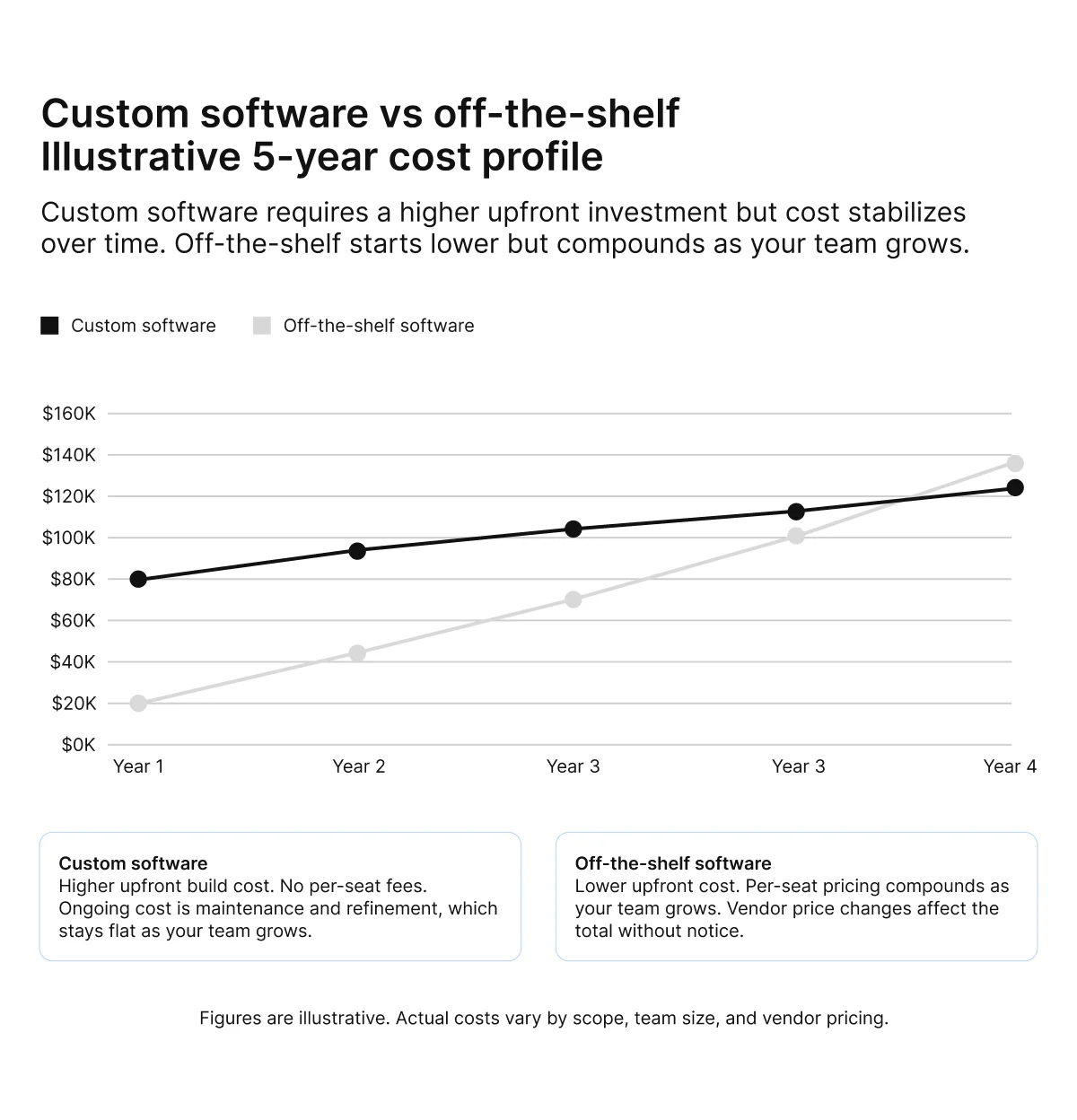
- The cost stabilizes over time: Custom software has no per-seat costs. The ongoing expense is maintenance and refinement, which stays flat regardless of how many people use the system.
- It creates a competitive advantage: When your competitors use the same platform, they have access to the same features and limitations. Custom software built around your proprietary processes creates an operational advantage that can’t be replicated, which is one of the main benefits of custom AI development services.
Disadvantages of Custom Software
Here’s what to factor in before getting started:
- Higher upfront investment and longer timeline: A custom build costs more to implement and takes longer to deploy. Depending on scope and complexity, the build can take three to six months, which is a real constraint for businesses that need something running immediately.
- Dependency on a capable development partner: A poorly scoped build creates technical debt that costs more to fix than to start over, which is why it’s important to understand custom AI agent development before engaging a partner.
- Ongoing post-launch maintenance responsibility: Custom software requires your development partner to handle updates, refinements, and infrastructure maintenance after launch, adding to the total cost of ownership.
What Is Off-the-Shelf Software?
Off-the-shelf software is a pre-built platform sold to a broad market. You pay a subscription or license fee, the vendor handles maintenance and updates, and your team configures the platform to fit your workflows as closely as the tool allows.
Common examples include Salesforce for CRM, HubSpot for marketing automation, SAP for enterprise resource planning, Zendesk for customer support, and Monday.com for project management. Each serves a wide range of businesses by covering the most common use cases in its field.
Advantages of Off-the-Shelf Software
For businesses with fewer unique workflows, a pre-built platform might be the stronger starting point. Here are the benefits of off-the-shelf software:
- Fast to deploy: A pre-built platform can have your team running within days, appealing to businesses that need operational tools immediately, are still validating a workflow, or aren’t yet ready to commit to a custom build.
- Lower upfront cost: The subscription model removes the upfront development cost entirely. For businesses with a limited initial budget or those not yet sure what their workflows will look like long term, this lowers the barrier to getting started.
- Continuous updates and vendor support: The vendor handles infrastructure, security patches, and feature updates. Your team benefits from product improvements without managing the technical side or depending on a development partner to keep the system current.
Disadvantages of Off-the-Shelf Software
The limitations of off-the-shelf software aren’t always obvious on day one. They tend to show up as your business grows and your workflows become more specific. Below are some of the main drawbacks:
- Your workflows have to fit the tool: Off-the-shelf software is built for the average use case. When your workflows differ from the average, the workarounds your team builds to compensate accumulate quietly and become their own maintenance burden over time.
- Costs grow with your team: Every new hire adds to the monthly subscription bill. A platform that fits the budget for five people may become one of the largest software costs in the business by the time the team reaches fifty, without the platform doing anything more than it did on day one.
- Switching platforms is harder than it looks: When you outgrow a platform or decide to move to a custom build, migrating your data, workflows, and integrations is rarely straightforward. The longer you have been on the platform, the more complex and time-consuming that process becomes.
Custom Software vs. Off-the-Shelf: Key Differences
Before getting into the advantages and disadvantages of each option, here is how they compare across the factors that matter most for a growing B2B business:
The right comparison between the two options is never the first invoice. It is the total cost over three to five years, factoring in per-seat pricing at your projected team size, the cost of workarounds your team builds to compensate for poor fit, and what a migration would cost if you eventually outgrow the platform.
The Hybrid Approach: When You Need Both
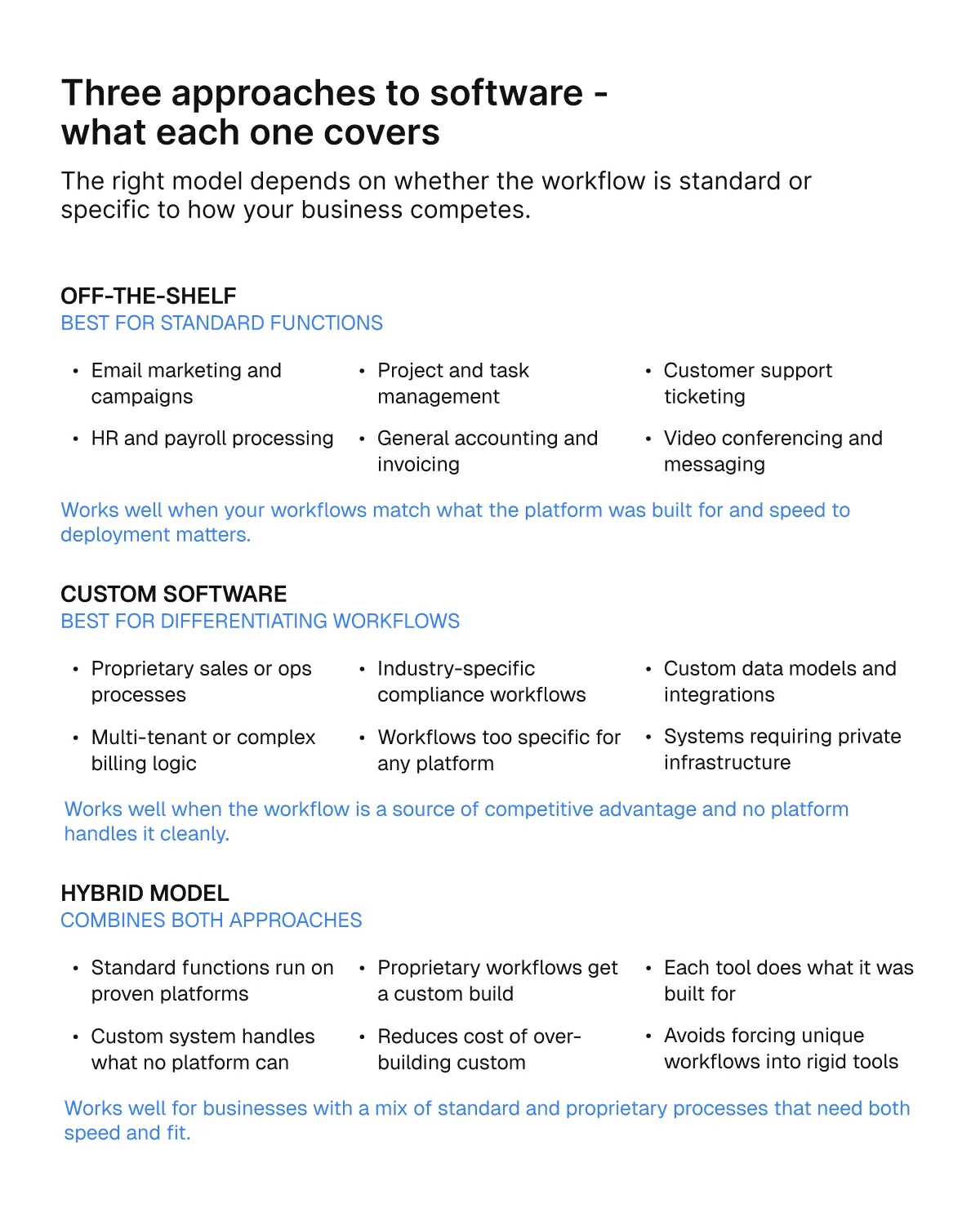
The choice between custom and off-the-shelf software is not always binary. A third path exists that combines both: off-the-shelf for standard business functions and custom software for the workflows that set your business apart.
A business might use HubSpot for email marketing and Zendesk for support ticketing while running a custom-built system for the proprietary workflow that is core to how they compete. Each tool does what it was built for. The custom system handles what no off-the-shelf platform can approximate without significant compromise.
This approach removes the pressure of choosing one option for everything. Standard functions run on proven platforms. Proprietary or revenue-critical workflows get a system built specifically around them.
How to Choose Between Custom Software and Off-the-Shelf
Asking questions can help you clarify the decision before you commit to either option. Here are some questions to ask before you choose:
- Is this workflow a source of competitive advantage or a standard business function? Build custom workflows that differentiate your business. Buy off-the-shelf for the ones that do not.
- Do you need something running in weeks, or can you plan for months? Speed favors off-the-shelf, while fit favors custom.
- What does per-seat pricing look like at your projected team size in three years? Run the numbers before signing anything.
- Does your data need to stay on private infrastructure for compliance or competitive reasons? If yes, off-the-shelf is unlikely to meet that requirement.
- Do you have access to a development partner who can own the build and support it after launch? Without one, a custom build carries real execution risk regardless of how well it is scoped.
When the answers point toward off-the-shelf, start there. A custom build makes sense when the difference between what a platform offers and what your business needs is wide enough that workarounds are already costing more than a build would.
If you have already worked through a custom CRM vs pre-built SaaS CRM decision, the same framework applies across any software category.
How We Capture Sales Builds Custom Software for B2B Teams
Working around a platform that does not fit your workflows has a cost that is easy to underestimate at first. It shows up in manual exports, duplicate data entry, and processes that depend on someone remembering to do something the software should handle automatically.
We Capture Sales builds custom AI-powered software around how your business specifically operates. Every engagement starts with a one-on-one discovery conversation that maps your current workflows, identifies where an off-the-shelf platform is falling short, and determines what the right build looks like before any development begins.
Here is what that looks like in practice:
- Pipeline Revival is a custom-built outreach system designed around your existing contact data, running email and SMS sequences that adapt based on open rates and response rates, and routing engaged prospects to a Calendly booking link or your website without manual handoff.
- Social AI is a custom content system built around your brand voice and target channels, generating branded posts across Instagram, X, Facebook, and LinkedIn from a URL or text input, organized in a content calendar your team copies and posts manually.
- Market Miner is a custom intelligence system built around your specific market, pulling live competitor activity and contact data filtered by your industry and location into clean CSV exports your team can act on directly.
- Knowledge Cloud is a custom knowledge system built around your internal documentation, making your existing business files queryable by any team member with every response source-linked and verifiable.
Pricing is per organization regardless of how many people use it, and every system is built around your specific workflows rather than configured to approximate them, which is the core difference in how to increase sales with AI automation when the right system is in place.
Your workflows deserve a system built around them.
Book a discovery call with the We Capture Sales team to get started.
Frequently Asked Questions
Can you switch from off-the-shelf software to custom software later?
Yes. The typical path is starting with an off-the-shelf platform to validate workflows quickly, then moving to a custom build once the limitations are clear. Running the off-the-shelf tool for 12 to 18 months often produces a much clearer brief for the custom build than any upfront planning process.
What happens to your custom software if your development partner shuts down?
If you own the code and documentation outright, another partner can pick it up. If the original partner retained IP rights or did not provide full documentation, the handover becomes significantly harder. Confirm code ownership in writing before any build begins.
Is off-the-shelf software secure enough for businesses handling sensitive data?
It depends on your compliance requirements. Enterprise platforms carry strong certifications but run on shared infrastructure. If your industry requires specific data residency or access controls, shared infrastructure may not be sufficient regardless of the vendor's certification level.


