




Picking the wrong software tool costs a small team more than money. It costs weeks spent onboarding, time spent adjusting workflows, and, eventually, the effort of migrating to something that actually fits.
Capterra's 2025 Tech Trends Report found that 58% of global businesses regret at least one software purchase made in the last 18 months, with more than half describing the financial impact as significant.
Our AI Office, HubSpot, and Salesforce are three of the most searched options for small B2B teams in 2026. This article breaks down what each tool is built for, what it actually costs, and which one fits which team so you can make an informed decision before signing anything.
Key Takeaways
- Our AI Office is a workspace with B2B automation add-ons, while HubSpot and Salesforce are CRMs, so the right choice depends entirely on which problem your team is trying to solve.
- HubSpot's free and Starter tiers are solid entry points, but the jump to Professional is steep and comes with a mandatory annual contract and onboarding fee.
- Salesforce is the strongest option for complex pipeline management, but implementation costs add significantly to the first-year total.
- Our AI Office charges per organization rather than per seat, so costs stay flat as your team grows.
- Our AI Office is the only option of the three that combines a daily AI workspace with B2B automation add-ons for outreach, content, and prospect intelligence.
Our AI Office Overview
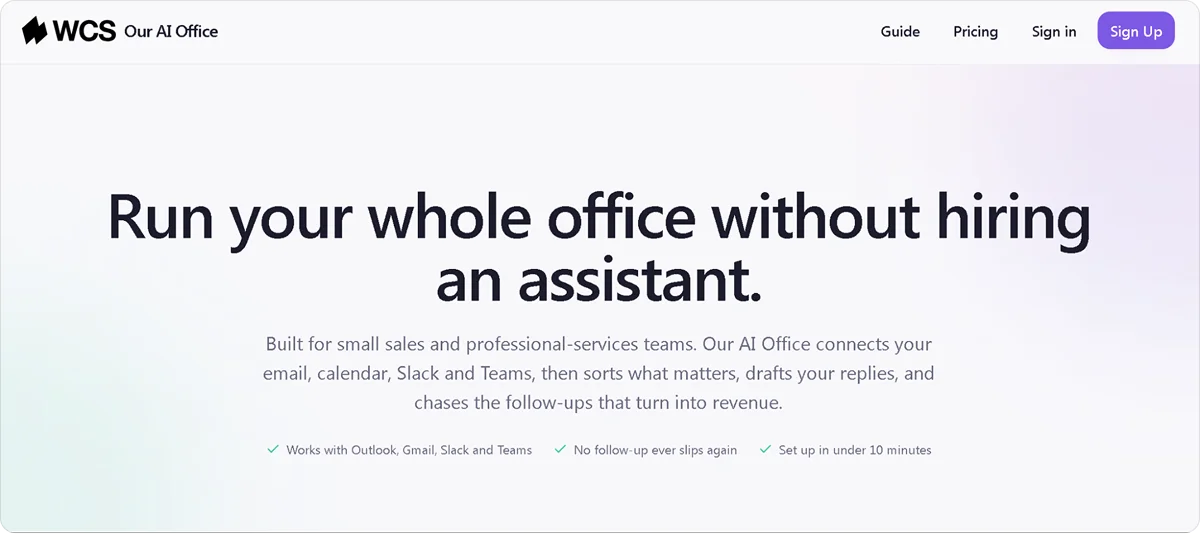
Our AI Office is an AI workspace built around daily productivity and B2B automation. It brings inbox, calendar, tasks, voice notes, and knowledge into one environment, with four automation products built on top: Prospecting for outreach, Social AI for content, Market Miner for prospect intelligence, and Knowledge Cloud for internal knowledge management.
Because the workspace and the automation products share data, each function draws from the same information rather than operating independently. That connection is what separates it from a standard productivity tool and from a standard CRM.
HubSpot Overview
HubSpot is a CRM and marketing automation platform built around contact management, email marketing, sales pipelines, and inbound marketing. The free tier covers basic CRM well. Paid tiers unlock automation, lead scoring, A/B testing, and advanced reporting.
It fits teams with a marketing-led buyer journey where content, landing pages, and lead nurturing drive most of the pipeline. The integration ecosystem is one of the largest available, with thousands of native connectors already built.
Salesforce Overview
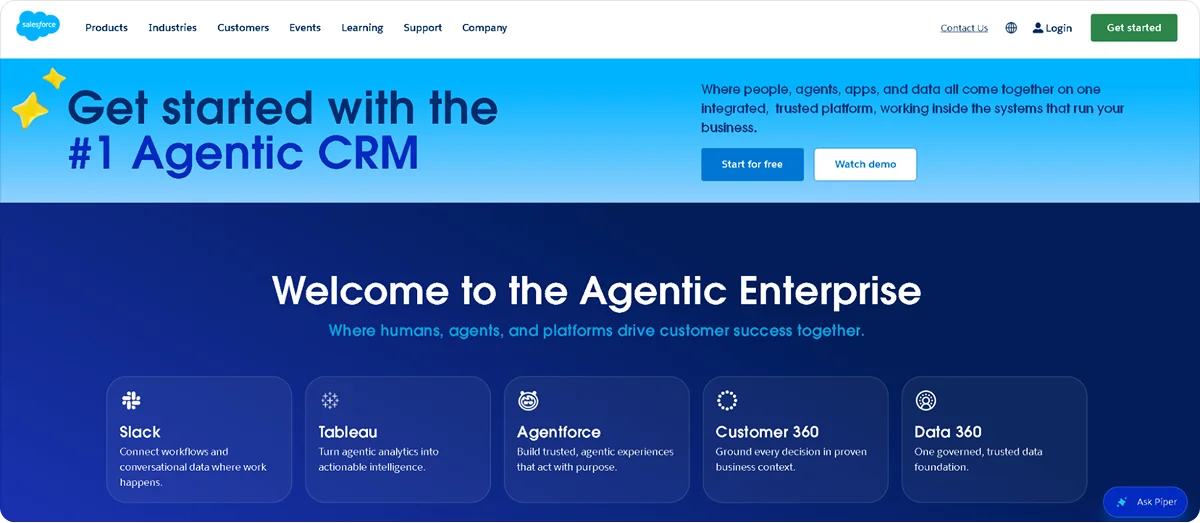
Salesforce is an enterprise CRM platform built around sales pipeline management, customer data, and a deep integration ecosystem through its AppExchange marketplace. It scales to any organization size without requiring a platform migration as the business grows.
The tradeoff for a small team is implementation complexity. Most teams need outside help to configure it correctly from the start, which adds to first-year costs before the platform delivers productivity gains.
Our AI Office vs. HubSpot vs. Salesforce: Pricing in 2026
Per-seat pricing, onboarding fees, and annual contracts all affect what you actually pay beyond the headline number. Here is what each tool costs across tiers:
Our AI Office charges a flat rate per organization. HubSpot and Salesforce charge per seat, which means every new hire increases the monthly bill.
A 10-person team on HubSpot Professional pays $890 per month plus a $3,000 onboarding fee in year one. The same team on Our AI Office pays $275 per month with no onboarding fee and no annual contract.
That difference grows significantly when you model it over two to three years, which is exactly what the custom SaaS development cost conversation tends to reveal before a team commits to a platform.
Our AI Office vs. HubSpot vs. Salesforce: Feature Breakdown
Features tell you what a tool can do. How those features are priced tells you what they will actually cost when your team needs them. Here is how the three tools compare:
Two things stand out. Our AI Office is the only tool with voice notes, weekly review, and decision tracking built in. HubSpot and Salesforce both charge per seat and lock you into annual contracts once you move beyond the free tier.
Where Each Tool Genuinely Outperforms the Others
No single tool wins across every category. Here is where each one has a real edge.
What Our AI Office Does Best
Our AI Office’s flat organization pricing is the most practical advantage for a small team. A team of 10 pays the same flat rate as a team of 3, with no annual commitment and no onboarding fee.
The workspace layer is also genuinely distinct from both HubSpot and Salesforce:
- Voice notes, weekly review, and decision tracking address daily operational friction that most CRM tools are not built to handle
- The B2B automation add-ons connect outreach, content, prospect intelligence, and internal knowledge into one system rather than four separate subscriptions
- AI sales automation compounds in value when tools share data, which is exactly what Social AI, Market Miner, and Knowledge Cloud do inside Our AI Office
What HubSpot Does Best
HubSpot's free CRM is one of the most generous free tiers available for small teams. Contacts, deal pipelines, email templates, meeting scheduling, and live chat are all included at no cost.
The inbound marketing tools are also the most developed of the three:
- Landing page builders, blog management, and A/B testing are more robust than in Our AI Office or Salesforce
- Lead nurturing workflows fit teams where content drives most of the pipeline
- The integration ecosystem is the largest of the three, with thousands of native connectors already built
What Salesforce Does Best
Salesforce has the most powerful sales pipeline management of the three. Deal stages, custom fields, territory management, and advanced reporting are more developed than in HubSpot or Our AI Office at any price point.
The AppExchange marketplace extends that further:
- Industry-specific apps and compliance tools are available through AppExchange in a way neither HubSpot nor Our AI Office can match
- Deep integrations with enterprise systems are more established here than anywhere else
- For teams that need a CRM that scales to any complexity, Salesforce is the most future-proof option
Which Tool to Choose Based on Your Situation
The right tool depends on what your team is actually trying to do. Four scenarios cover most situations small B2B teams face.
Small Founder-Led Team
If you are running a lean operation and need inbox, calendar, outreach, and content handled without switching between four apps, Our AI Office is the most practical starting point. The workspace covers daily productivity with no annual contract and no per-seat pricing as the team grows.
It is built for teams thinking through how to increase sales with AI automation without the overhead of managing separate subscriptions.
Marketing-Led Team Running Inbound Campaigns
If most of your pipeline comes from content, landing pages, and email nurturing, HubSpot Free or Starter is the stronger fit. The inbound marketing tools and email sequences are the most developed of the three for this use case.
Starter starts at $20 per seat per month and covers the basics well. The jump to Professional at $890 per month plus a mandatory $3,000 onboarding fee is significant and worth evaluating carefully against what features your team actually needs before committing to an annual contract.
Sales Team With a Complex Pipeline
If your team manages multiple deal stages, needs detailed reporting, and wants pipeline visibility across a large number of accounts, Salesforce Starter Suite is the strongest option of the three for this use case.
Pipeline management and reporting are more developed here than in HubSpot or Our AI Office at the equivalent price point. Factor in $2,000 to $5,000 for implementation support in year one before calculating the total first-year cost.
Growing Team Needing Workspace and B2B Automation
If your team needs daily productivity tools and B2B automation running from one place as you scale, Our AI Office with the relevant add-ons covers both layers. The workspace handles inbox, calendar, and tasks. Social AI and Market Miner handle outreach, content, and prospect intelligence. No per-seat pricing cliff as headcount grows.
For anyone working through the buy vs. build custom software decision, Our AI Office gives you the benefits of a pre-built platform with enough configurability to match how your business actually operates.
Pricing Considerations for Each Tool
Every tool has tradeoffs that the pricing page does not show. Here is what to verify before signing up for any of them.
Our AI Office
Our AI Office does not include a visual drag-and-drop sales pipeline in the traditional CRM sense. If your team needs deal stages and pipeline views as a core function, confirm whether the current feature set covers that before signing up
HubSpot
The free and Starter tiers are genuinely useful, but the features most growing teams actually need sit behind the Professional paywall. Before assuming Starter will be enough, check where your requirements land:
- Workflow automation, lead scoring, A/B testing, and custom reporting all require Professional at $890 per month plus a mandatory $3,000 onboarding fee
- Per-seat pricing means every new hire adds to the monthly bill. Model the cost at your projected headcount in 12 months, not your current team size
- Annual contracts on Professional and above apply from day one, which makes switching costs real the moment you commit
Salesforce
Salesforce is the most capable of the three but also the most demanding to set up and maintain. Before choosing it for a small team, account for what the first year actually costs:
- Implementation typically requires outside help, which adds $2,000 to $5,000 to the first-year cost on top of per-seat licensing
- Adoption takes longer than HubSpot or Our AI Office. Factor in training time before expecting full team productivity
- AppExchange apps that extend core functionality often carry separate licensing fees that are not visible on the main pricing page
How Our AI Office Fits into a Small B2B Team's Operation
HubSpot and Salesforce are built for teams with a dedicated operations function managing the platform. Our AI Office is built for small teams that need everything running without a specialist to maintain it.
The workspace handles the daily operational layer. The B2B automation add-ons handle the growth layer, connecting outreach, content, prospect intelligence, and internal knowledge into one system rather than three separate subscriptions:
- Social AI: Generates branded content across Instagram, X, Facebook, and LinkedIn, organized in a calendar your team copies and posts manually
- Market Miner: Pulls live competitor activity and contact data filtered by industry and location into clean CSV exports
- Knowledge Cloud: Makes your internal documentation queryable by any team member, with every response source-linked and verifiable
That connection is what makes AI sales automation compound in value when the tools share data rather than operate independently. Every system runs on private infrastructure, and pricing stays flat per organization regardless of headcount.
Start your free trial or book a demo call to get started.
FAQ
Can you use HubSpot and Our AI Office together?
Yes. They serve different primary functions, so there is no direct conflict. HubSpot handles CRM, contact management, and inbound marketing. Our AI Office handles the daily workspace layer and B2B automation.
Some teams use HubSpot as their system of record for contacts while running outreach and content through Our AI Office's add-ons. Whether that makes sense depends on which functions you are getting from each tool and whether the overlap justifies paying for both.
What happens to your HubSpot data if you switch to a different tool?
HubSpot allows you to export contacts, companies, deals, and activities as CSV files. Email sequences, workflow logic, and templates do not export automatically and need to be rebuilt in the new tool.
Run the export before committing to a new platform so you understand what transfers cleanly and what needs manual work.
Is there a tool that combines CRM and workspace productivity in one place?
Our AI Office is the closest option in 2026. It combines inbox, calendar, tasks, voice notes, and knowledge management in one workspace, with B2B automation add-ons for outreach, content, and prospect intelligence.
It doesn't have a traditional drag-and-drop sales pipeline, so teams that need that as a core function should factor it in before switching.


