




Institutional knowledge is everything your team knows about how the business actually works: the processes that are not written down, the client relationships built over years, and the judgment calls only experienced staff can make. It keeps daily operations running smoothly and rarely gets formally documented until someone leaves and takes it with them.
This article covers what institutional knowledge is, why it matters for your business, what losing it actually costs, and how to preserve it before it becomes a problem.
Key Takeaways
- Institutional knowledge includes both documented processes and the unwritten expertise your team builds through experience. Both types matter and both require different approaches to preserve.
- The cost of losing institutional knowledge goes beyond recruitment. It shows up in slower onboarding, repeated mistakes, and disrupted client relationships.
- Traditional preservation methods like documentation and exit interviews work but share a common limitation: they depend on someone actively choosing to capture knowledge before it is needed.
- AI changes knowledge preservation by making your existing information queryable, source-linked, and accessible to any team member in real time.
- The businesses that protect institutional knowledge most effectively treat it as an operational asset, not just an HR concern.
What Is Institutional Knowledge?
Institutional knowledge is the collective understanding a business builds over time through experience. It includes the processes your team follows, the decisions that have been made and why, the client context your account managers carry, and the unwritten rules that influence how work gets done.
What makes it different from general knowledge is specificity. A new hire can bring industry experience, technical skills, and professional judgment from previous roles. What they cannot bring is an understanding of how your business specifically operates.
That specificity is what makes institutional knowledge valuable and what makes losing it expensive.
Types of Institutional Knowledge
There are different types of institutional knowledge across an organization. For B2B businesses specifically, three types have the most direct impact on operations, client relationships, and team performance.
Explicit Knowledge
Explicit knowledge is documented and transferable. Anyone with access to the right document can use it without needing to ask someone who was there when it was created.
Explicit knowledge is easy to preserve because it already exists in a format you can access. The challenge is keeping it current and making sure it is findable when someone else needs it.
Tacit Knowledge
Tacit knowledge is experience-based and harder to document. It is the judgment a senior employee applies without consciously thinking about it, the relationship context a long-tenured account manager carries about a key client, and the unwritten understanding of how decisions get made.
A new hire can read every document your business has produced and still not know how to handle a difficult client conversation the way someone who has been doing it for five years would. That gap is tacit knowledge, and it is the more dangerous type to lose because it is the harder type to replace.
Implicit Knowledge
Implicit knowledge sits between explicit and tacit. It is knowledge that exists in practice across your team but has never been formally documented. Your team applies it consistently without thinking about it, but if you asked someone to write it down, they could.
A good example is how your team qualifies a new client before taking them on. The criteria might be clear to everyone who has been there long enough, but if it has never been written down, a new hire has no way to access it without asking. Implicit knowledge is the most actionable type to preserve because it can be documented with relatively little effort once it is identified.
Importance of Institutional Knowledge
Institutional knowledge is not just an HR concern. It has a direct impact on how efficiently your business operates, how quickly new hires become productive, and how well your team protects the advantages it has built over time.
It Keeps Operations Running Without Interruption
When institutional knowledge is well-preserved, your team does not need to stop and figure things out from scratch every time a process runs. New hires can reference documented context. Decisions get made faster because the context behind them is accessible rather than locked in someone else's memory.
It Shortens the Time It Takes New Hires to Contribute
A new hire at a company with well-preserved institutional knowledge gets productive faster because the context they need is accessible from day one. They spend less time figuring out how things work and more time doing the work.
That ramp-up difference has a measurable impact on output, especially in roles where client context and process nuance matter. The same principle applies across AI business process automation: the quality of information available to a system determines how well it performs.
It Protects Competitive Advantage
The ways your business operates, the client relationships your team has built, and the process improvements developed over the years are not easily replicated. When that knowledge is accessible and preserved, it stays with the business. When it is not, it leaves with the people who carry it.
What Institutional Knowledge Loss Costs a Business
Most businesses do not think about institutional knowledge until someone leaves. By then, the cost is already accumulating. Here is where it shows up.
Slower Onboarding and Higher Ramp-Up Costs
When a new hire joins a team that has not preserved its institutional knowledge, they spend weeks figuring out how things work rather than doing the work. That lost time has a direct cost: productivity delayed, mistakes made, and senior staff pulled away from their own responsibilities to answer questions that should already be documented.
According to SHRM, replacing an employee costs between 50% and 200% of their annual salary depending on their level. That figure covers recruitment and onboarding, but it does not fully account for the operational slowdown that follows when the institutional knowledge that person carried is not available to whoever replaces them.
Repeated Mistakes and Lost Process Improvements
When knowledge is not preserved, the same problems get solved from scratch every time. A process improvement one team member developed gets lost when they leave. A mistake that was corrected two years ago gets made again because nobody documented the fix.
This compounds as team size grows. A five-person team has enough shared context to catch most of these gaps informally. A fifty-person team does not, and the cost of repeated mistakes grows proportionally with the number of people who do not have access to the same institutional context.
Disrupted Client Relationships
In B2B, client relationships often stay in the heads of the people managing them. A long-tenured account manager carries context about a client's preferences, communication style, and history that rarely appears in any CRM record.
When that person leaves, the relationship does not transfer automatically. The new account manager starts from whatever is in the CRM, which is rarely the full picture. Clients notice the gap, and the trust built over years takes time to rebuild, if it gets rebuilt at all.
How Businesses Currently Preserve Institutional Knowledge
Several approaches exist for preserving institutional knowledge. Each one has genuine value and a clear limitation.
These methods share a common limitation. They depend on someone actively choosing to capture and share knowledge before it is needed. When a team is busy, that step gets skipped and when someone leaves unexpectedly, there is no time for it at all.
The result is that knowledge preservation tends to be reactive rather than proactive, and the businesses that feel the cost most sharply are the ones where knowledge transfer was not treated as an ongoing process.
For teams already running AI tools for business automation across other functions, the same principle that makes automation reliable applies here: the system is only as good as the information it works from.
How AI Changes Institutional Knowledge Preservation
AI does not replace the need to capture institutional knowledge. What it changes is what happens after you capture it.
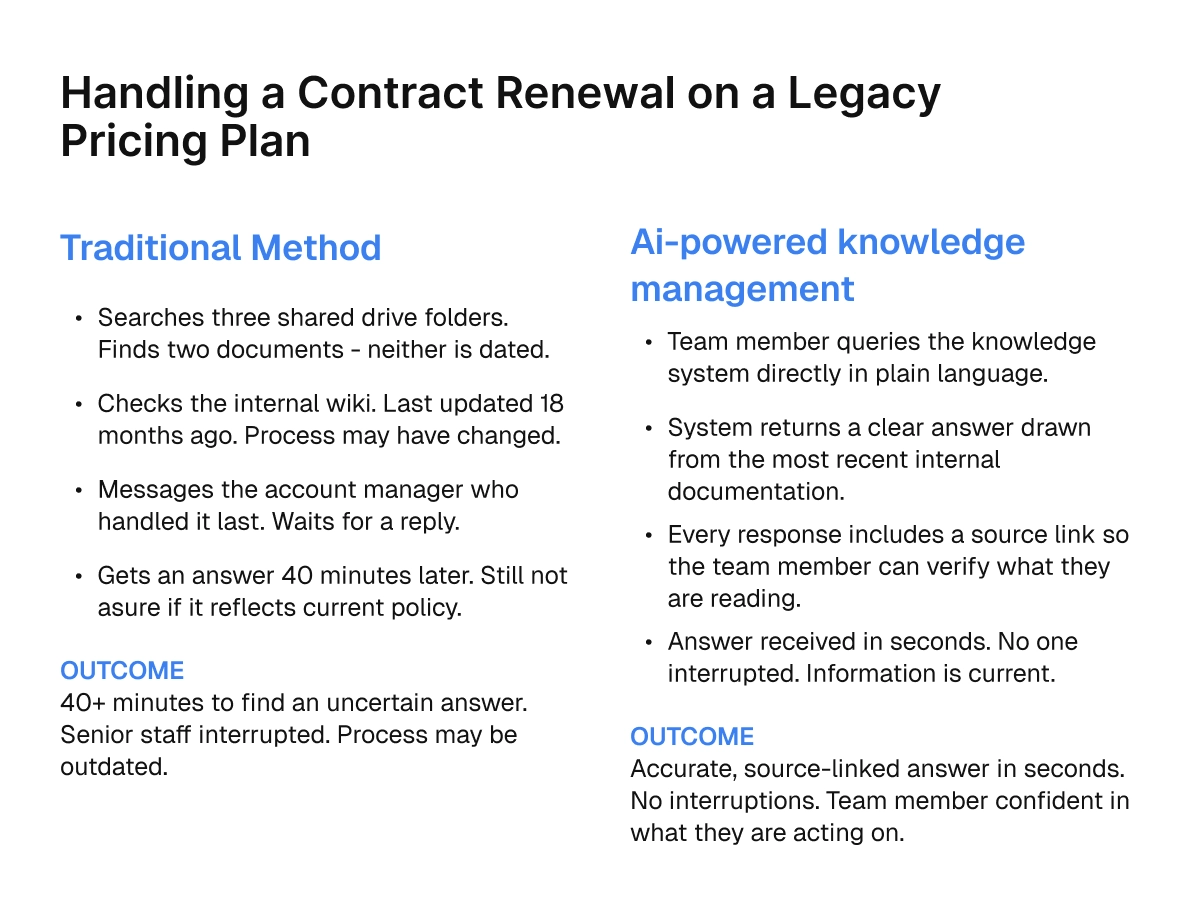
Traditional preservation puts information into a document, folder, or wiki and hopes someone can find it when they need it. AI-powered knowledge management makes that information queryable: a team member asks a question and receives a source-linked answer drawn from your existing files, rather than hunting through folders hoping the right document exists and is current.
Three specific improvements AI makes to knowledge preservation
- From periodic updates to continuous accuracy: AI systems connected to your files reflect current information rather than whatever was last manually updated. A pricing document updated last week is immediately available in every query response, without anyone having to manually update a separate knowledge base.
- From individual memory to organizational memory: Knowledge that previously lived in one person's head becomes accessible to the entire team, without that person having to be present or available to answer questions.
- From static documents to queryable knowledge: Rather than searching through folders and wikis, your team asks a question and gets a source-linked answer drawn from your existing files and documents. The information does not need to be in a specific place or formatted a specific way to be findable
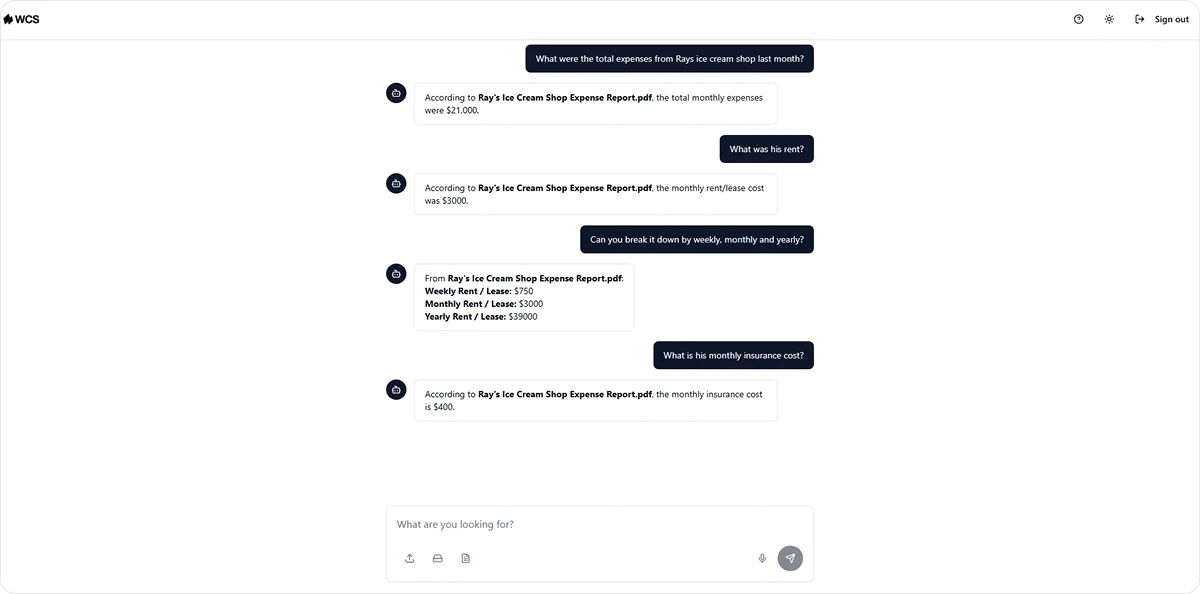
Knowledge Cloud at We Capture Sales takes that a step further, connecting directly to your existing files so your team can query internal information the same way they would search the web, with every response source-linked and verifiable.
If you are thinking about building this capability as part of a broader custom AI development strategy, knowledge management is one of the functions where the return shows up fastest, because the information already exists.
How We Capture Sales Preserves Institutional Knowledge for B2B Teams
Every business accumulates knowledge over time. The problem is that the knowledge stays in too many places: email threads, shared drives, the heads of long-tenured staff, and documents that were accurate when they were written but have not been touched since.
We Capture Sales’ Knowledge Cloud addresses that specific gap. Rather than asking your team to maintain a separate knowledge base or remember to update a wiki, Knowledge Cloud connects to your existing files and makes that information queryable by any team member directly.
Here is what that looks like in practice:
- A new account manager preparing for their first call with a key client queries the system and gets relevant context from past meeting notes, proposals, and internal documents, with sources attached so they can verify what they are reading.
- A sales rep preparing for a competitive pitch queries the system for positioning against a specific competitor and gets a response drawn from your most recent internal documentation rather than something written two years ago.
- An operations lead looking for the process behind a workflow that runs once a quarter queries the system rather than interrupting the one person who has run it before.
Every system runs on private infrastructure. Your business knowledge never touches a public AI model, never gets shared with other clients, and stays within your environment.
If a key team member left tomorrow, how much of what they know would your business be able to recover?
Book a discovery call with the We Capture Sales team to find out how Knowledge Cloud can make your institutional knowledge accessible to everyone on your team.
Frequently Asked Questions
What is the difference between institutional knowledge and organizational knowledge?
Institutional knowledge is specific to how your organization operates: the processes, relationships, and judgment calls that have developed over time within your business. Organizational knowledge is a broader term that includes everything a business knows, including general industry knowledge, market data, and formal training materials.
The distinction matters because institutional knowledge is harder to replace when lost. It cannot be learned from a textbook or brought in from outside the way general industry knowledge can.
How do you identify institutional knowledge before it is lost?
Start by identifying the people whose absence would create the most operational disruption. Ask which processes depend on a single person's memory, which client relationships are managed by one individual, and which decisions require someone who has never documented how they make them.
Those are the concentration points where institutional knowledge is most at risk and where preservation efforts should start.
Can institutional knowledge be rebuilt after it is lost?
Some of it can be rebuilt over time through new experience and documentation. But the knowledge most valuable to a business, the context behind long-standing client relationships and the reasoning behind decisions made years ago, is difficult to reconstruct accurately once the people who held it have left.
The more time passes, the harder accurate reconstruction becomes.


