





A marketing team deploys an AI agent, watches it run for three months, and still cannot say whether it made the budget back. That gap between adoption and proof is the real story behind agentic AI in B2B marketing right now.
Gartner found that marketing leaders expect AI-driven automation of marketing work to more than double, from 16% in 2026 to 36% by 2028. That pace of expected growth raises a harder question: whether the returns organizations are seeing justify the investment being made.
This article covers the ROI of agentic AI in B2B marketing automation, why a meaningful share of deployments fail to break even, and how to measure ROI before you commit budget to it.
Key Takeaways
- Agentic AI differs from standard automation by reasoning through multi-step workflows and adjusting based on outcomes, not just executing fixed rules.
- The strongest ROI shows up in lead scoring, outreach sequencing, content production, and market intelligence, the workflows that combine high volume with a consistent pattern.
- A meaningful share of agentic AI deployments fail within the first three months, most commonly due to unclear success criteria and poor data quality.
- ROI cannot be measured without defining the metric before deployment. Unmeasured returns cannot be defended in a budget review.
- A custom AI system built around your specific marketing workflows produces more reliable returns than a generic platform configured to approximate the same outcome.
What Is Agentic AI in B2B Marketing Automation
Standard marketing automation follows fixed rules. A contact takes an action, and a predefined response fires. It is reliable for simple triggers but does not adapt when a contact behaves in a way the original setup did not account for.
Agentic AI marketing automation works differently. Rather than following one fixed path, it plans a sequence of actions toward a goal and adjusts that sequence based on what happens at each step. It can identify a high-intent segment, build a targeted outreach sequence, launch it, and adjust the approach based on response data, all without a person directing each step.
Here is how the three levels compare:
That distinction is what determines whether a deployment produces measurable ROI or simply adds another tool to the stack. Understanding AI automation business opportunities helps clarify which workflows are worth automating in the first place.
Where Agentic AI Delivers the Strongest ROI in B2B Marketing
ROI from agentic AI is not evenly distributed across every marketing function. It concentrates on workflows that run at high volume and follow a repeatable enough pattern that an agent can handle them without human intervention.
Four areas consistently produce the strongest returns:
- Lead scoring and qualification
- Outreach sequencing and follow-up
- Content production and distribution
- Market intelligence and prospect research
Lead Scoring and Qualification
Agentic AI continuously analyzes behavioral signals, firmographic data, and intent data to qualify leads in real time rather than on a scheduled review cycle. Contacts that show genuine buying intent get flagged earlier, so your sales team can prioritize them.
Pairing this with a strong process for turning cold contacts into active prospects compounds the return, since cleaner input produces more accurate scoring output.
Outreach Sequencing and Follow-Up
The most consistent ROI driver in agentic marketing is removing the gap between a contact engaging and your team responding. Agentic AI runs multi-touch sequences that adapt based on how each contact responds, routes engaged contacts automatically, and keeps every prospect in an active workflow without manual tracking.
We Capture Sales's Pipeline Revival handles this directly. It ingests your existing CRM or CSV contacts and runs email and SMS sequences that adapt based on open rates and response rates, routing engaged prospects to a Calendly booking link or your website without manual handoff.
This is the same mechanism behind effective follow-up automation, running continuously across your full contact list without manual input.

Content Production and Distribution
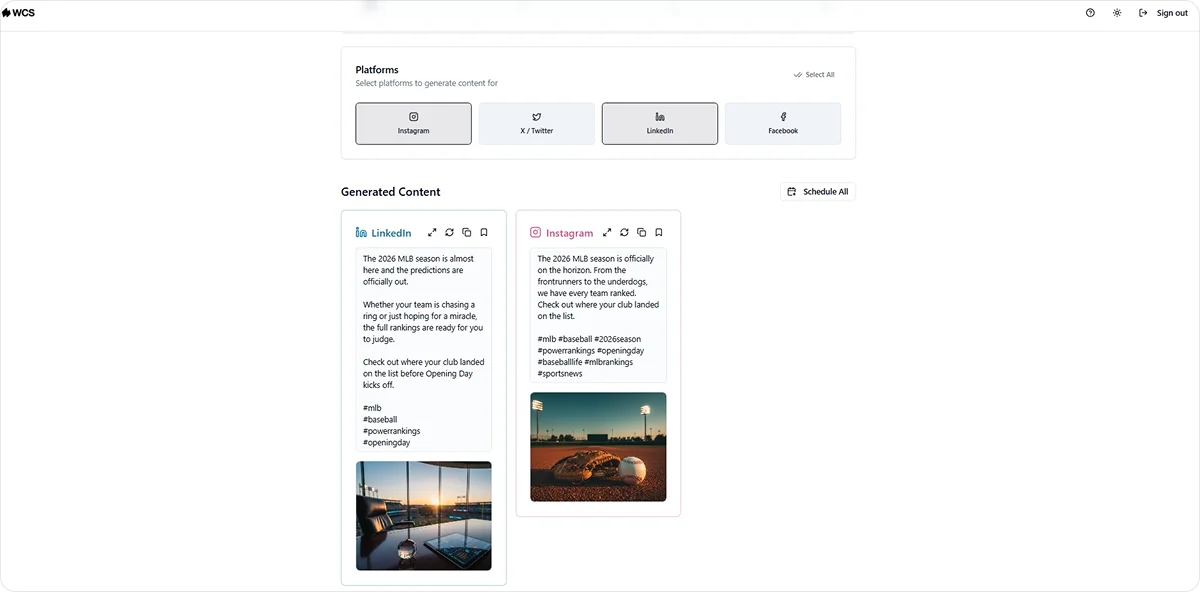
Content is one of the highest-volume, most time-consuming workflows in any B2B marketing team. Agentic AI generates platform-specific content variations, organizes them into a distribution calendar, and keeps brand voice consistent without proportional increases in team time.
We Capture Sales's Social AI handles this across Instagram, X, Facebook, and LinkedIn, generating branded posts with AI-produced images and relevant hashtags, organized in a content calendar your team copies and posts manually.
Market Intelligence and Prospect Research
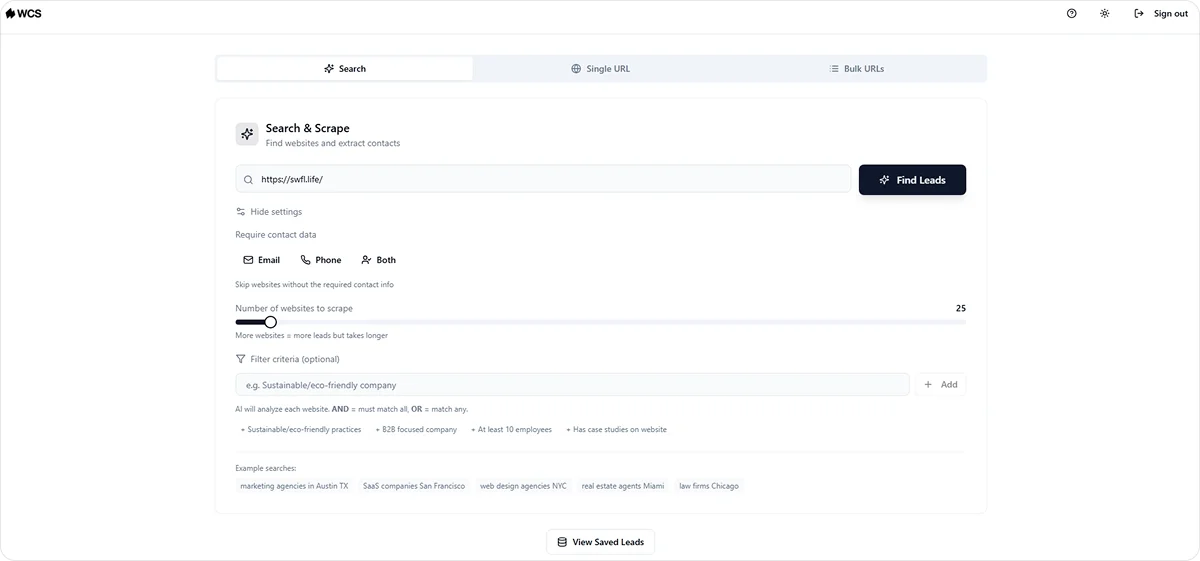
Manual market intelligence consumes significant team time without producing proportional returns. Tracking competitor activity, monitoring buying signals, and building prospect lists by hand do not scale with a growing pipeline.
We Capture Sales's Market Miner monitors those sources continuously through web scraping, pulling competitor activity and contact data filtered by industry and location, and delivering clean CSV exports your team can act on directly. For teams building lists from live data, web scraping for lead generation covers which sources produce the most actionable buying signals.
Why Many Agentic AI Deployments Fail to Deliver ROI
Gartner predicts that more than 40% of agentic AI projects will be canceled by the end of 2027, as a result of increasing costs, unclear business value, or lack of risk controls. That figure is not a warning about the technology itself, but reflects how most organizations are deploying it.
Three patterns explain most of those failures:
- Unclear success criteria: Without a defined outcome before deployment, there is no baseline to measure against. When budget reviews arrive, teams cannot show whether the system delivered value or not, and projects get cut not because they failed but because nobody can prove they succeeded.
- Poor data quality: An agent works with whatever data it has access to. Incomplete, outdated, or fragmented data restricts what the agent can do and produces unreliable outputs regardless of how capable the underlying model is.
- Agent washing: Same Gartner report notes that many vendors rebrand existing chatbots, automation tools, and RPA systems as agentic AI without delivering genuine autonomous capability. Teams investing in these tools are paying agentic prices for standard automation.
Across all three patterns, the technology is rarely the limiting factor. The decisions made before deployment determine whether the investment delivers.
How to Measure ROI From Agentic AI in B2B Marketing
ROI cannot be measured if the baseline was never established. Three metrics are worth tracking from the start of any deployment.
- Cost per qualified lead: Does the agentic system reduce the cost of generating a lead that meets your ICP criteria compared to your current process? This is the most direct comparison between automated and manual cost structures.
- Time recovered from execution work: How many hours per week has your team stopped spending on the workflow that the agent now handles? This is the most immediate and easiest metric to track, and it produces an early signal of whether the deployment is working as intended.
- Pipeline contribution: What percentage of pipeline generated in a given period can be attributed to workflows the agentic system handles? This is the metric that ultimately justifies continued investment, and it requires your CRM and your AI system to share data from day one.
Building this measurement infrastructure before deployment, not after, is what separates a program that can defend its budget from one that cannot. The same principle applies when implementing marketing automation and AI more broadly.
How We Capture Sales Delivers Measurable ROI From Agentic AI
B2B marketing teams evaluating agentic AI often face a choice between generic platforms that approximate their workflows and a custom build they assume will take too long to scope properly. We Capture Sales solves that by starting every engagement with a discovery conversation that defines the success metric before any development begins.
That sequencing matters because the most common reason agentic AI deployments get canceled is not the technology, but the absence of a defined outcome before anything is built. We Capture Sales builds around a measurable result from day one, so the system your team receives is scoped to deliver a return your team can track and defend.
Each product connects to a specific, measurable return:
- Pipeline Revival: Minimizes cost per qualified lead by automating outreach and follow-up sequences that adapt based on engagement, without requiring additional headcount
- Social AI: Reduces content production cost by generating platform-specific posts at a volume your team could not produce manually
- Market Miner: Saves the hours your team spends on manual prospect research and competitor tracking
- Knowledge Cloud: Recovers the time your team spends locating internal information before every campaign or client conversation
Every system runs in a fully isolated AWS environment. Your data never touches a public AI model, and pricing stays flat per organization regardless of team size.
If your team is evaluating agentic AI and wants a system scoped around a measurable outcome from the start, that is exactly what the discovery conversation establishes.
Reach out to book a call today.
Frequently Asked Questions
How long does it take to see ROI from agentic AI in marketing?
Workflows that operate on contacts and data already in your pipeline, such as follow-up sequencing, tend to show measurable results within the first few weeks. Workflows that depend on building new data sets, like market intelligence, take longer to show their full return. Starting with one well-scoped deployment and measuring its impact before adding others consistently produces clearer, faster results.
How do you know if your business is ready for agentic AI in marketing?
Three signals suggest your team is in a good position to deploy:
- You have a marketing workflow that runs at high volume and follows a consistent enough pattern for a system to manage without constant human direction
- Your contact data is clean, centralized, and connected to your CRM, so the agent is working from accurate inputs from day one
- You can define a specific, measurable outcome before deployment, whether that is cost per qualified lead, time recovered from execution work, or pipeline contribution
If any of those three are missing, addressing them first produces better results than rushing into a tool purchase.
Do AI agents replace your existing marketing automation setup?
No. AI agents work alongside your existing marketing tools, not in place of them. Your current setup still handles campaign execution, rule-based segmentation, and triggered emails.
The agent handles the layer that requires judgment: deciding which accounts to prioritize, adjusting sequences based on real-time behavior, and routing contacts without waiting for manual input. Teams that expect agents to replace their current stack often end up rebuilding integrations they did not need to break in the first place.


